
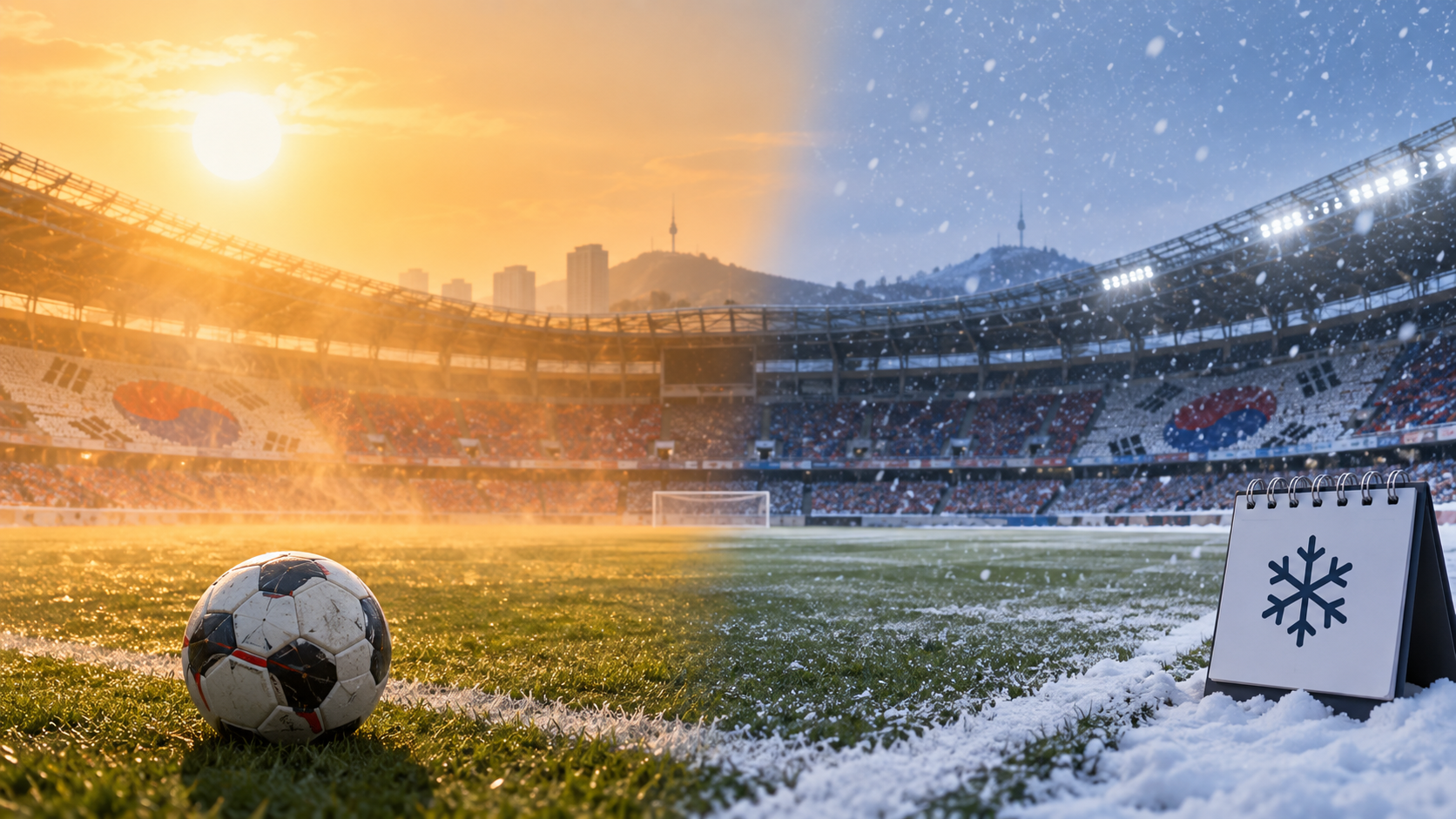
South Korean football is searching for the ideal period in which to stage the K-League. Winters have traditionally been bitterly cold, while summers are becoming increasingly oppressive. Despite the country’s peaceful nickname, its weather is often anything but mild.
A recent survey showed that more than 70% of the 29 coaches who responded from Asia’s oldest professional league favor replacing the usual March-to-November calendar with a European-style season beginning in late August and including a winter break.
The issue has been discussed for years, but rising summer temperatures have made it more urgent. Yangsan reached 42.5 degrees Celsius on 2 August, the highest temperature recorded there, while Seoul experienced 17 tropical nights in succession, meaning temperatures remained above 25 degrees.
Supporters collapsed at stadiums, and coaches complained that the heat was affecting the standard of football. Conditions may deteriorate further. A December 2025 report by the Korea Meteorological Administration found that national temperatures increased by 0.9 degrees between 2020 and 2024, an alarming rise considering that the total increase during the preceding century was 1.9 degrees.
The Korea Pro-Footballers’ Association urged the league to revise its calendar. It said the competition must adopt a new schedule to safeguard players from the escalating climate crisis and severe summer heat, while also preserving its leading position in Asia and its ability to compete internationally.
Players argue that matching the European calendar would improve conditions for both athletes and supporters while making transfers easier to complete. Japan has already adopted this approach. Its league previously followed the same timetable as Korea but has now begun its first campaign under the revised calendar.
Japanese supporters and journalists have often expressed frustration at the modest transfer fees paid for the country’s increasing supply of gifted young footballers. Sharing Europe’s three-month summer transfer window could improve those returns. The change also aligns the domestic competition with the Asian Champions League, which moved to an autumn-to-spring format in 2023.
Korea faces an additional difficulty because its 38-match campaign involves a harsher winter than Japan’s for many teams. Watching football in intense summer heat is unpleasant, but attending games in temperatures below freezing is equally challenging. According to the national weather agency, summers have lengthened by 25 days since the early 20th century, while winters have shortened by 22 days. If that pattern continues, the required winter break may be shorter than previously expected, although a substantial pause during midsummer could still be necessary.
A revised calendar could be introduced relatively soon without causing excessive disruption. Japan used a separate transition competition running from February to May before the World Cup. The 2030 tournament could offer Korea a similarly convenient opportunity to make the switch.
China currently uses the same seasonal format as Korea and also experiences severe winters in some regions and intense summer heat across much of the country. The shorter 30-match top-flight campaign provides some relief, while China’s vast geography allows matches during the coldest periods to be scheduled in warmer southern locations.
The financial performance of Japan’s revised season may influence decisions elsewhere. Long mid-season interruptions could reduce matchday income and weaken attention among supporters and broadcasters, but officials in Tokyo predicted record revenue before the campaign began. If that forecast proves accurate, financial success may persuade other leagues as much as concerns about overheated players and spectators.
Climate pressures are also affecting sports beyond football. The Indian Premier League, cricket’s richest competition, is considering moving away from its usual March-to-May window. League chair Arun Dhumal said increasingly severe heat in May had become another major concern, adding that organizers were examining possible dates between February and April, as well as another period later in the year.
The Tour de France faces similar questions after extreme heat and wildfires disrupted the summer event. Conditions became so dangerous that spectators were advised to avoid the closing stages for their own safety.
XDS Astana sports director Yvon Ledanois described the conditions as unprecedented. He emphasized that the problem was not limited to a single exceptionally hot day, but involved relentless extreme temperatures throughout the event.
Moving the race away from July, its traditional place on the calendar for roughly 120 years, does not yet appear likely. However, organizers may soon need to adjust starting times so riders avoid the hottest hours of the day. In Korea and across the sporting world, adaptable scheduling is becoming increasingly important.
What do you feel about this post?

Like

Love

Happy

Haha

Sad