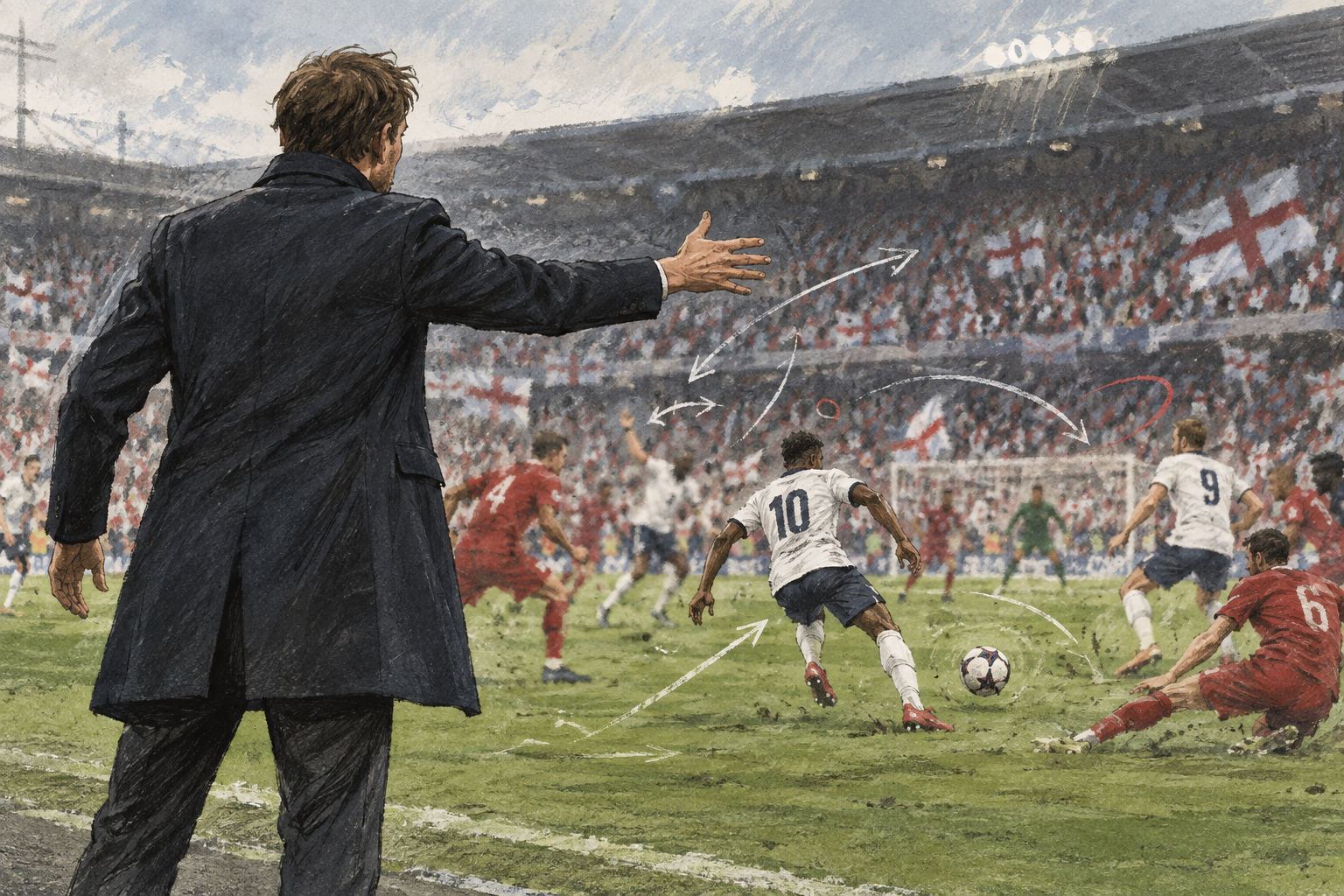
Thomas Tuchel has acknowledged that he sometimes wants his side to exercise more authority over matches. However, the England manager believes the fast, unpredictable and high-energy style associated with the Premier League should continue to shape his approach as he pursues success at Euro 2028.
Tuchel said his team may not use their energy in the most efficient way because they frequently play at maximum intensity. England ran out of steam during July’s World Cup semi-final defeat by Argentina. After taking the lead in the 55th minute, they struggled to keep possession or manage the contest, allowing Argentina to turn the game around with two late goals.
The manager would like England to resemble Spain for brief periods when under heavy pressure, particularly in their ability to keep and control the ball. Even so, he intends to build his tactics around the qualities of his players, the footballing habits they developed and the energetic style valued by supporters in England.
That creates a personal dilemma for Tuchel, who finds it difficult when his team cannot control proceedings. Looking towards the next international cycle and Nations League fixtures against Spain, Czechia and Croatia, he nevertheless said England must learn to accept and use the disorder that comes with their natural approach.
“It is something I continue to debate with myself,” he said. “Even when Premier League teams control games, how many English players are central to that approach? Is control truly part of our footballing identity? Is it something we naturally appreciate and find comfortable? Or is the instinct to move forward quickly whenever the ball remains in midfield?”
“I have watched England training sessions performed at an exceptionally high standard, with tremendous pace, quick movement of the ball, physical strength and confident dribbling. That leaves me considering exactly when and how we should slow things down. It becomes especially difficult in a World Cup semi-final against Argentina, with most of the stadium supporting them, to suddenly ask the team to play like Spain for 15 minutes.”
Asked whether England dropped deep to protect their 1-0 advantage against Argentina because they lacked control, Tuchel agreed that this played a part. He added that a slow, carefully managed finish does not naturally appeal to many English supporters. Although winning remains the priority, crowds generally prefer matches to stay open and attacking, while players from other countries may be more accustomed to controlling the tempo.
“At heart, English players and supporters want to attack, and that is one of their greatest qualities. They would often rather see a 6-3 or 4-3 contest than a cautious 1-0 result. The traditional instinct is to move the ball forward. English football does not have a long history of patiently keeping possession near the halfway line, building slowly from deep and drawing opponents out. The tendency is to deliver the ball into the opposition area and compete for it.”
“Having now experienced a major tournament, I know this squad is always prepared to compete and push forward. That willingness is one of its main strengths. In the most demanding moments, however, we may need to improve our football, show slightly more bravery and use our energy more effectively. That could be the direction we take.”
Tuchel was told that England possess enough technically accomplished players to include periods of sustained possession against the strongest opponents. He responded that international management does not provide enough time to teach such a detailed system. In his view, he has entered an established football culture and should make the most of its many strengths rather than attempt to replace it with a completely different model. He believes such a change would not match the natural qualities of his squad.
Tuchel described his feelings about the World Cup as mixed, largely because of the loss to Argentina, and admitted England could have performed better throughout the tournament. Still, he refuses to let the second half of that semi-final erase the progress made elsewhere. Victory over France in the third-place playoff secured the country’s best finish at a major tournament since 1966.
“I never described the tournament as a major success,” Tuchel said. “I said it contained many encouraging signs, but it still felt incomplete. Yet we should also ask why expectations are so extreme. How recently have we won the competition, and how often have we ever won it? Finishing with a bronze medal should still receive some recognition.”
What do you feel about this post?

Like

Love

Happy

Haha

Sad