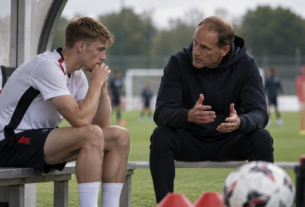
After Czechia’s 2-0 loss to England in Prague, their coach turned left, headed down the touchline, shook Thomas Tuchel’s hand and used a phrase he could not remember ever saying after a match: “See you soon.” Tuchel responded with the same words. Just seven days later, after separate trips through Oviedo and Rijeka, they are due to face each other once more at Wembley. “Four games in 11 days leaves no time for training or anything else. I haven’t heard one international coach say they enjoy the new format,” Santi Denia says, although he is smiling and can still see the positive side.
It marks the beginning of a new chapter, but one filled with familiar people and warm reunions. Extremely familiar, in fact. Czechia could hardly have received a more difficult Nations League draw, yet Denia could scarcely have asked for opponents he knows better. In Oviedo, his side faced his homeland and many of his former players. In London, they will meet England for the second time in a week, taking on another group of footballers whose development he has followed closely. It is another reunion.
The chance to lead Czechia emerged from a discussion with a longtime friend during the World Cup, where Denia watched Spain defeat Argentina and complete a journey years in the making. Of the 26 Spanish players who became champions in New Jersey, 23 had worked with him during his 15 years at the national federation. He coached teams from under-15 through under-23 level and contributed throughout the youth system. These were the players he had helped guide, leaving him with memories of Rodri and Lamine Yamal when they were much younger. Throughout that period, England’s youth teams were among those he encountered most often.
That explains the affection and respect in Denia’s voice as he speaks between a run of fixtures against England, Spain and England again, while his phone repeatedly vibrates on the table. There is optimism as well. He has admired Phil Foden for around a decade, describing him as a player who makes the difference, and he strongly supports the work done by England’s football authorities and the current generation. “You are this close to winning a World Cup,” he says, holding his thumb and forefinger only a fraction apart.
Denia, a European champion and Olympic gold medal-winning coach who also helped reorganise Spain’s youth structure, believes England are nearing a major breakthrough. His Spain under-17 side defeated England on penalties to win the 2017 European Championship, only for England to respond by beating them in the World Cup final later that year. England also overcame Spain in the 2023 European under-21 final, with Curtis Jones scoring and James Trafford stopping a penalty. Denia’s final match in charge of a Spanish team, in 2025, was also against England, so he considers it appropriate that his first two Czechia fixtures against the same opponent have arrived so quickly.
“When you represent Spain, meetings with England are almost inevitable,” he says. “There have been many finals and important occasions. I remember visiting St George’s Park with Luis de la Fuente and facing England in Huelva. Their staff came to observe our work, and we travelled to Bisham Abbey to study theirs. I joined the Spanish federation in 2010, and England’s development system has since made enormous progress. Winning European and world titles at under-17 level, followed by the under-21 European Championship, came from trusting young players and investing in their growth. Those players received opportunities and experience that later benefited the senior team. England’s authorities recognised the value of that approach. Clubs and the available talent remain important, but facilities and player education provide the foundation.”
Anthony Gordon is one of the players Denia has encountered several times. Asked about Gordon’s suggestion that England should not attempt to imitate Spain, Denia responds enthusiastically: “Gordon? What an outstanding player! He is young, fearless, quick and dangerous in one-on-one situations. He belongs in the same conversation as the best talents of his age. English football deserves great credit for producing players like him. Each country has its own identity, and that must be understood and protected. Transformation cannot happen instantly, because success takes time. Mistakes are inevitable, but the destination must remain clear. During my 15 years with Spain’s youth sides, we kept developing, adjusting and improving. Studying other federations is not imitation; it is education.”
“England are an exceptionally strong team and are virtually within touching distance of a World Cup final. I regularly defend the work being done there. They consistently rank among the best two or three national sides in the world. The investment has produced results, and it should continue, particularly in young footballers, coaching education and facilities such as St George’s Park. That is essential. In 2006, Spain had won no more major honours than Czechia.”
Spain have since become two-time world champions. “Coaching involves more than the sport itself,” Denia says. “A player once told me, ‘You are not only a coach; you are a teacher.’ That is especially true in youth football. Winning matters, but education matters as well. There is a psychological and almost parental responsibility. These footballers are still children, each going through emotional development. You learn about their personal difficulties and help them grow. Luis and I have occasionally excluded gifted players because their presence could damage the group. An individual cannot win everything alone. Messi may be the only exception.”
“Their success fills you with pride. I watched the World Cup final beside David Gordo, Spain’s under-21 coach. We embraced without speaking, but the look between us said, ‘We played our part.’ We cannot claim responsibility for the victory, although we contributed something small to the journey. Over 15 years, nearly every player had spent time under our guidance.” David Raya, Víctor Muñoz and Aymeric Laporte were the only exceptions, although Denia had previously competed against Laporte.
Now Denia must try to overcome the same players he once helped develop. “And I want to defeat them,” he says with a laugh. “I’ll call Luis and tell him they have won enough. He has the finest players available, but managing such a group still requires exceptional skill. He is a master and, without question, the best coach in the world.”
His attempt fell short in Oviedo, where Czechia became Spain’s latest opponent to lose, going down 3-1 on Saturday. Even so, Denia’s affection remains intact, as does the pride he feels when seeing former pupils become world champions.
Ferran Torres scoring the decisive goal in the World Cup final brought back familiar memories for Denia. “Watching Ferran score gave me a sense of deja vu. He also found the net in the under-19 European final and won the under-17 European Championship, so that experience carried into the senior side. Then there are Lamine and [Pau] Cubarsí, who attended an under-15 tournament in Sweden. I have worked with remarkable players: Isco was extraordinary, as were Thiago [Alcântara] and [Sergio] Canales. But this was the first occasion when I saw spectators holding their heads and asking, ‘What is this?’ José Lana was the coach, and I asked him where he had discovered those players. I was fortunate because I managed the under-19s and promoted Lamine. He was only 14, which was a record. I immediately wanted him in my team.”
Youth coaches can also lose their strongest players when they are promoted to higher age groups or the senior squad. Denia insists that never bothered him. “I was delighted whenever it happened. Seeing a player reach the senior team is the greatest source of pride. I used to tease Luis by saying, ‘You don’t dare take my players.’ He would answer, ‘Do not challenge me, because I will take every one of them.’ There should be no hesitation. A player’s birth date does not matter; readiness is what counts. National coaches may know their ability, but clubs must provide opportunities. We encourage clubs to trust young footballers, although very few would play Cubarsí and Lamine at 16.”
Denia’s phone rings again. He notices a Czech number before returning to the subject of Spain’s captain. “I cannot judge Rodri without emotion,” he says. “I first watched him at Atlético alongside academy director José María Amorrortu. We were looking down from a balcony during an infantil under-14 training session when I noticed a very small boy playing brilliantly. Josema told me it was Rodri. I replied that he seemed one second ahead of everyone else but was tiny. Josema pointed toward Rodri’s parents in the stands; both were very tall. We decided he would grow and that we could wait. I remember his under-17 debut in Sweden. I told him not to fight physical battles he could not win. His advantage was intelligence and quicker thinking. His growth spurt arrived later at Villarreal. Speaking to him is like talking with a coach or a wise grandfather because he is always ready to offer advice.”
Rodri lifting the World Cup represented the conclusion of years of work by Denia and his colleagues, but the tournament in the United States also opened another path. Czechia coach Miroslav Koubek had stepped down, and Denia was watching a match with Radek Bejbl, the former Czech Republic international who had been his teammate at Atlético. “Radek told me he knew Pavel Nedved, Czechia’s general manager, and asked me to send a résumé explaining my work with Spain. Federation president David Trunda was also in New York. We met there and later held another discussion in Prague with Nedved about how we could develop the team. I was delighted to accept.” Bejbl has since joined Denia’s staff.
Denia leans closer as he describes his new surroundings. “Czechia is remarkable, and Prague is incredible,” he says. English expressions have occasionally appeared throughout the conversation, and the reason soon becomes clear. “We communicate with the players in English. My assistant, Pablo Amo, speaks it very well, while Radek translates certain details. Sometimes a Spanish swearword escapes. Knowing three or four important Czech words and using some English is enough because football is understood everywhere. Reaching the World Cup was already an achievement. Our next task is to improve, expand and create a clear route for players. We know the style we want, and the squad has embraced it.”
“We need to establish a structure in which every department works together and responsibilities are clearly defined, including medical services, communications, marketing and travel. If the federation wishes, we can also support the youth teams and introduce ideas gained in Spain. However, we have only just arrived and have not yet had enough time. The first and most important responsibility is selecting the correct players. We must scout matches, determine the qualities we need and choose footballers who suit that profile. After that, only a few days remain to shape the team. International coaches always have limited preparation time, and this schedule makes the challenge even greater. We lost to Croatia but remained competitive, and the same was true against England. Neither the staff nor the federation doubts the direction we are taking. David and Pavel have placed their trust in us. We must respect Czechia’s traditional identity while also adding something of our own. The immediate goal is to qualify for the European Championship.”
The conversation turns once more to England. “I would accept that opportunity immediately,” Denia says as his phone vibrates again and signals that it is time to leave. “A European Championship in England would be wonderful. I know many of the stadiums and training facilities, and I remember visiting [Aitor] Karanka in Middlesbrough. Driving there was the difficult part; the football was what I enjoyed. I would love to return and play there. Imagine reaching another final against England. It may be an ambitious dream, but why shouldn’t we aim that high?”
What do you feel about this post?

Like

Love

Happy

Haha

Sad