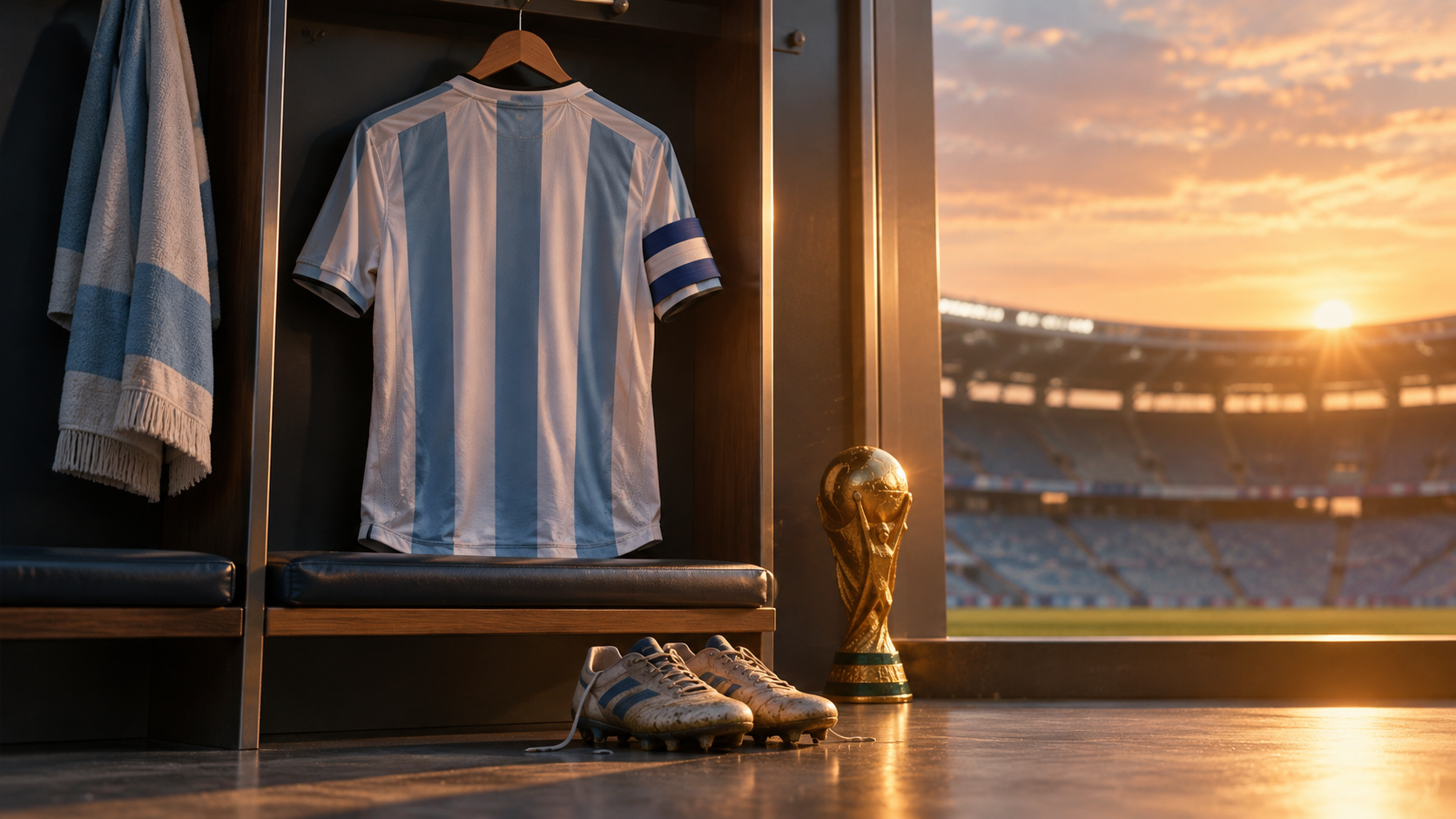
Not for the first time, Lionel Messi is making a return to Argentina’s national side. This appearance, however, carries a feeling of celebration and closure rather than duty, as the country prepares to honour arguably the finest footballer in history. Messi will pull on the Argentina jersey for the final time this week in a Buenos Aires friendly against Benin, having accepted an invitation for a farewell appearance following his decision to end his international career after the World Cup final.
This is not the first time Messi has stepped away from international football. In 2016, after losing a major final for the third consecutive year, he appeared ready to bring his Argentina career to an end. Following the Copa América Centenario defeat by Chile, he described the moment as extremely painful and said that, after four unsuccessful finals, he believed leaving the national team was the right choice. Despite repeatedly pursuing a major trophy, he felt his opportunity had passed.
Around six weeks later, following a nationwide campaign asking him to reconsider, Messi confirmed that he would continue representing his country. Another decade in Argentina colours followed, producing a remarkable collection of achievements. After finally lifting the World Cup, becoming his country’s most-capped player with 208 appearances after Tuesday’s match, and setting its scoring record with 125 goals, he has nothing left to demonstrate.
Argentina’s accomplishments during the past five years make the first 16 trophyless years of Messi’s international career seem almost impossible to believe. The team lost Copa América finals in 2007, 2015 and 2016, in addition to suffering defeat against Germany in the 2014 World Cup final.
There were few immediate signs of improvement after Messi reversed his retirement decision in 2016. Argentina endured a disastrous 2018 World Cup campaign after struggling through qualification. Reports of unrest among the players emerged following a 3-0 group-stage loss to Croatia, before France eliminated them in the round of 16, although Argentina pushed the eventual champions hard in a memorable match in Kazan.
Messi temporarily withdrew from international duty again after the 2018 tournament in Russia. Argentina then entered a difficult period, dismissing head coach Jorge Sampaoli and replacing him with one of his assistants. The appointment proved unpopular, with Diego Maradona questioning whether the new coach had the experience and authority required to lead the national side.
The man Maradona doubted was Lionel Scaloni. Whatever questions surrounded his appointment, Scaloni soon demonstrated that he was highly capable of guiding Argentina.
Scaloni and Pablo Aimar seemingly persuaded Messi that his absence did not need to become permanent. It proved to be a decisive turn of events, especially because Scaloni was reportedly appointed partly because he represented a simple and affordable option. Seven years later, he stands alone among Argentina coaches in having won both the World Cup and multiple Copa América titles, with Messi playing a central role in each triumph.
Messi has made more appearances under Scaloni than under any other Argentina manager, collecting 79 caps during his tenure. That statistic reflects the strength of their partnership. Scaloni constructed a system that allowed Messi to exert maximum influence in attacking areas without demanding extensive defensive work from him.
His teammates compensated by covering more ground and taking on additional defensive responsibilities. They appeared proud to do that work, knowing it enabled Messi to concentrate on his greatest strengths. Images of the squad following him out for warm-ups at the 2026 World Cup reinforced the impression of a group completely united behind its captain.
Their commitment was understandable. Argentina won consecutive Copa América titles on either side of their victory at Qatar 2022, securing the country’s first World Cup since 1986, and then reached another final at this summer’s tournament. It was a period of success unmatched by Argentina for a generation.
Messi holds the record for appearances in the men’s World Cup with 34 matches and shares the mark for participating in the most editions, having played in six. Much of his tournament legacy, however, is closely connected to his final two campaigns. Of his record 33 direct World Cup goal contributions, 22 came across the 2022 and 2026 tournaments. His 10 contributions in Qatar matched the highest total at that competition, while only Kylian Mbappé, with 14, surpassed Messi’s tally of 12 in North America.
Messi also briefly became the leading scorer in men’s World Cup history when two goals against Austria took him to 18, moving him beyond Miroslav Klose. He eventually finished with 21 tournament goals, one fewer than Mbappé’s total of 22.
His performances this summer included goals in nine consecutive World Cup matches, a record-breaking sequence that began during Argentina’s successful 2022 campaign in Qatar. He established another landmark by becoming the first player to start three men’s World Cup finals, doing so in 2014, 2022 and 2026. Cafu is the only other player to have appeared in three such finals.
The 2022 triumph in Qatar remains the defining achievement. Winning the tournament removed the final argument commonly used by Messi’s critics. The 2021 Copa América title had not satisfied those who continued to compare him with Pelé and Maradona, both of whom had lifted the World Cup. Messi answered that criticism in 2022 by inspiring Argentina to the trophy. Although defeat in 2026 was still painful, his earlier success ensured that his international legacy could no longer be questioned.
Scaloni’s contribution to this era should not be overlooked. Numerous Argentina managers had previously attempted and failed to win international honours with Messi, including some who could call upon squads containing greater individual talent.
Tuesday’s match will therefore underline that Argentina are moving into a new period, accompanied by uncertainty over what the team can accomplish without Messi. Their long-time leader remained their outstanding performer through his final appearance. The key question is whether Argentina can replace his imagination and finishing ability, or whether the unity and collective effort developed under Scaloni will be enough to carry them forward.
The answer will emerge with time. For now, Argentina can celebrate everything achieved during Messi’s extraordinary career, knowing such an era may never be repeated. The country had already produced one generational icon in Maradona, and discovering a third may take many years. Fortunately, Messi leaves behind enough unforgettable moments to be treasured for a lifetime.
What do you feel about this post?

Like

Love

Happy

Haha

Sad