
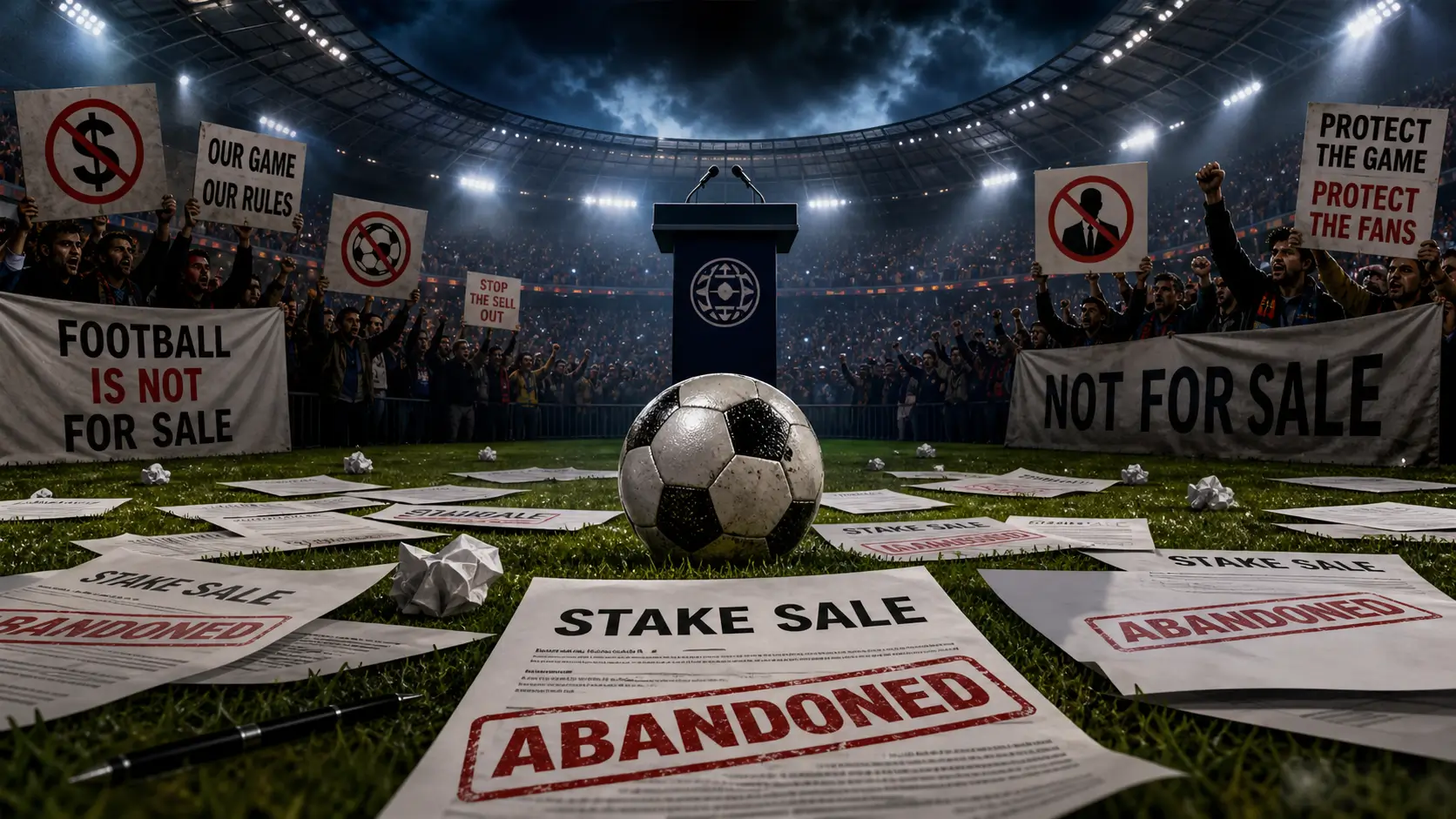
Gianni Infantino’s controversial plan to sell portions of the World Cup’s commercial assets to private investors has fallen apart. The Fifa president acknowledged that the initiative had caused divisions that ultimately undermined its original purpose, following strong opposition across international football.
The proposal triggered widespread unrest throughout the sport, with Uefa warning that it could boycott future Fifa competitions unless the idea was abandoned. Several other confederations also opposed the project. Carlos Cordeiro, one of Infantino’s senior advisers, resigned on Friday over the plan, while Fifa chief operating officer Kevin Lamour criticised the president for attempting to advance it with limited consultation and what he described as a serious lack of respect.
The intense backlash forced Infantino to withdraw the proposal. Reports also suggested that Thrive Capital, the venture capital company heading the potential investment group, had developed concerns after a turbulent week for the sport. Infantino’s previously stable leadership is now under considerable strain, and it remains uncertain whether abandoning the project will be enough to protect his position.
In a statement, Infantino said that after carefully considering the different opinions, he had concluded that the proposal had become too divisive to continue, regardless of how much support it might still have attracted.
He added that the organisation’s goal had always been to bring people together and strengthen the game, meaning the project would not move forward. Infantino said he planned to gather the relevant parties again over the coming days and weeks to pursue their shared interests and support football’s development worldwide, especially in countries requiring the most assistance.
The Fifa Forward Enterprise (FFE), announced earlier in the week, was designed to generate hundreds of millions of dollars by offering investors a substantial share of the commercial rights connected to the men’s and women’s World Cups and the Club World Cup. Organisers claimed the arrangement could increase distributions to more than $10bn (£7.5bn) across Fifa’s 211 member associations. Federations were given until 19 September to join, with participating members eligible for an optional payment of $20m (£14.8m).
European associations firmly rejected the initiative and agreed at an emergency meeting on Thursday to stage a boycott. Concacaf and the Asian Football Confederation also publicly expressed their opposition, with the Asian body issuing a particularly forceful statement on Friday morning. Although Infantino continued to enjoy significant backing in Africa, he lacked sufficient support to implement the proposal in a credible form.
Focus will now shift to Infantino’s future after the scale of the rebellion inside Fifa and the damage caused to his reputation elsewhere. Scrapping the plan may not persuade associations already unhappy with his management of the Folarin Balogun matter, which emerged during the World Cup three weeks earlier. Some observers have suggested, however, that using part of Fifa’s reserves—estimated at about $4bn (£2.97bn)—to provide the money promised through FFE could help him regain enough support to remain in office.
Uefa and other confederations have intensified efforts to identify candidates willing to challenge Infantino in next year’s Fifa presidential election, where he had previously been expected to secure a fourth term with little difficulty. Their determination is unlikely to weaken, and it remains to be seen whether he can recover from an episode that has seriously damaged his credibility.
What do you feel about this post?

Like

Love

Happy

Haha

Sad