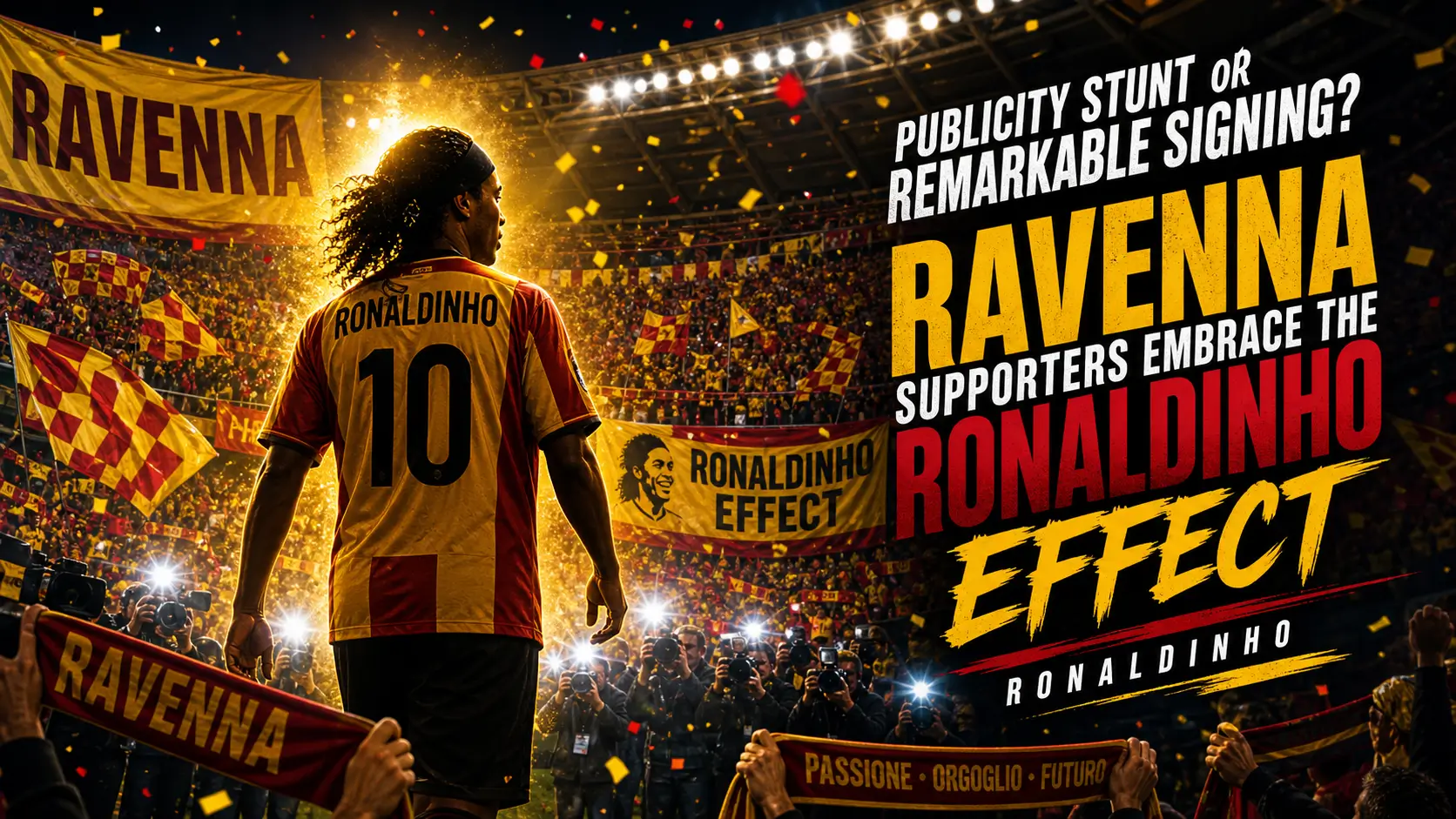
On a blazing summer day in Ravenna, a city celebrated more for ancient Byzantine mosaics and Dante’s resting place than sporting success, people in the historic centre are searching for one of football’s most famous faces. The man in question is Ronaldo de Assis Moreira, widely known as Ronaldinho, who once appeared in a World Cup final interval performance with Madonna and Ronaldo.
“There has been no sign of him so far,” four Ravenna fans joke while sitting outside a cafe and browsing La Gazzetta dello Sport, Italy’s distinctive pink sports newspaper. Although they suspect the deal is mainly a commercial exercise, they still hope to see the 2005 Ballon d’Or recipient and 2002 world champion wearing the club’s yellow and red colours.
The scene offers a strange snapshot of the excitement sweeping through this peaceful part of Emilia-Romagna, largely because of Ignazio Cipriani’s entrepreneurial vision. A member of the Venetian hospitality family associated with Harry’s Bar, Cipriani acquired Ravenna in 2024 while the team competed in Serie D, Italy’s fourth division. Born in the city, he is also the grandson of Raul Gardini, the chemicals businessman and yachtsman who guided Il Moro di Venezia to the 1992 America’s Cup final.
During Cipriani’s first season as president, Ravenna won the Serie D Cup and earned promotion to the professional Serie C. He regards those achievements only as the beginning of a much larger journey: “This is not something I said merely to attract attention. From my first day, I made Serie A our objective because I genuinely plan to take the club there. Beyond that, the Champions League is the destination we ultimately hope to approach one stage at a time. I set such a demanding target because pressure forces people to find answers rather than explanations. I want to eliminate excuses from the outset.”
Cipriani then produced an extraordinary surprise during the summer. The announcement appeared so unlikely that many readers initially believed it was a joke: Ronaldinho, now 46, was returning to play for Ravenna.
“I was introduced to him by Lorenzo Tonetti and Ariedo Braida,” Cipriani explains. “Both spent more than two decades working at AC Milan and knew Ronaldinho during his time there. I had dreamed of involving him from the moment I purchased Ravenna. Lorenzo and Ariedo helped us meet, our conversations developed, and we formed a sincere friendship. That connection generated several ideas about how the club could progress. As for the question everybody keeps asking, I can confirm that Ronaldinho intends to play in a Ravenna shirt. Perhaps he will even score the final goal of his career for us.”
A dedicated online store has already released a limited-edition jersey displaying “R10”, the Brazilian star’s personal emblem. Every shirt was purchased within hours, illustrating the remarkable combination of worldwide premium branding, lower-league football and carefully planned promotion.
“Had anyone told me three years ago that Ronaldinho would join Ravenna, I would have thought they had lost their mind,” says Fabio, laughing. A supporter throughout his life, he remembers how the announcement immediately generated international attention. “Suddenly, reports around the world were linking Ronaldinho with Ravenna. It was an exceptional piece of business.”
Ravenna has never been one of Italy’s major football powers. Financial collapses in 2001 and 2012 contributed to many years of movement between the lower divisions, while seven campaigns in Serie B remain the club’s peak. In a city traditionally associated with volleyball, football supporters became familiar with limited resources and local rivalries.
“Ronaldinho is unlike any other football figure,” Cipriani says. “The joy and imagination in his game inspired people of my generation. Our hope is that he can now encourage younger supporters in Italy and elsewhere to develop a connection with Ravenna. This involves more than gaining publicity. We are trying to connect different periods of the sport while creating an international community around the club.”
As part of the wider sporting and commercial plan, Ravenna is cooperating with the local authority on improvements to the Stadio Bruno Benelli, including an increase from its current capacity of 6,300. Cipriani’s larger ambition is to construct a multi-use complex operating throughout the week, with shops, spaces for live music and a Hotel Cipriani incorporated into the city’s strategy for attracting more overseas visitors.
Ravenna’s mayor, Alessandro Barattoni, believes the involvement of such an internationally recognised player complements efforts to strengthen the city’s profile abroad. Ravenna has recently sought to expand its appeal beyond seaside holidays and port-related commerce. Connections with English-speaking countries have also grown, supported by a visit from members of Britain’s royal family and the launch of the Lord Byron Museum.
“Ronaldinho gives Ravenna an entirely different degree of international recognition,” Barattoni says. “Once the announcement became public, former classmates filled my phone with messages. Children today may first encounter him through old videos online, but his appeal has not disappeared.” The mayor adds with a smile that he would gladly show Ronaldinho the city’s historic and cultural landmarks if their schedules allow it.
Barattoni nevertheless stresses the boundaries of the municipality’s involvement: “The club and the city share an interest in reaching an international audience and presenting Ravenna to people worldwide. Ronaldinho has represented many major companies across the globe, and this wider initiative can give the team enormous exposure while helping the city promote projects outside the usual tourist paths.” He continues: “The club was already making impressive progress with younger supporters before this deal. Those attending matches are now younger on average, more energetic and increasingly involved. A real community is emerging.”
Some long-standing fans, however, remain concerned that the club could become excessively commercial. Marketing campaigns are treated carefully in the Curva Mero. “A number of groups are understandably hesitant,” Fabio says. “The modern game often promotes developments that many supporters reject, including more expensive tickets and reduced access for families with limited incomes. Because of that, publicity campaigns and commercial spectacles can provoke suspicion.”
Cipriani says he fully understands those concerns: “An international vision is meaningless unless it remains connected to local roots. Ravenna is not a new product invented by the current ownership. It has a past and a character that were here long before we arrived. Heritage does not prevent progress; it provides the base for it. A football club has no true value without its community.”
“I am 50 and have attended matches here since I was at school,” says another supporter, Giovanni. “The excitement I felt years ago is returning. If Ronaldinho and a businessman from Ravenna can make us imagine reaching Serie A, I welcome it. What matters is ensuring that the loyal fans in the stadium are never overlooked.”
Seeking to capitalise on the surge of attention surrounding Ronaldinho, Ravenna has opened its season-ticket campaign with an objective of 2,800 sales. Prices have increased by roughly 12% on average, although the precise rise depends on the area of the ground.
For the moment, Ravenna is enjoying an extraordinary sense of momentum and anticipation. The club is recruiting players capable of challenging for the championship, while residents are looking ahead to 20 August. Ronaldinho is scheduled to attend a three-day summer celebration in nearby Marina di Ravenna, an event being arranged with Cipriani’s characteristic sense of spectacle.
What do you feel about this post?

Like

Love

Happy

Haha

Sad