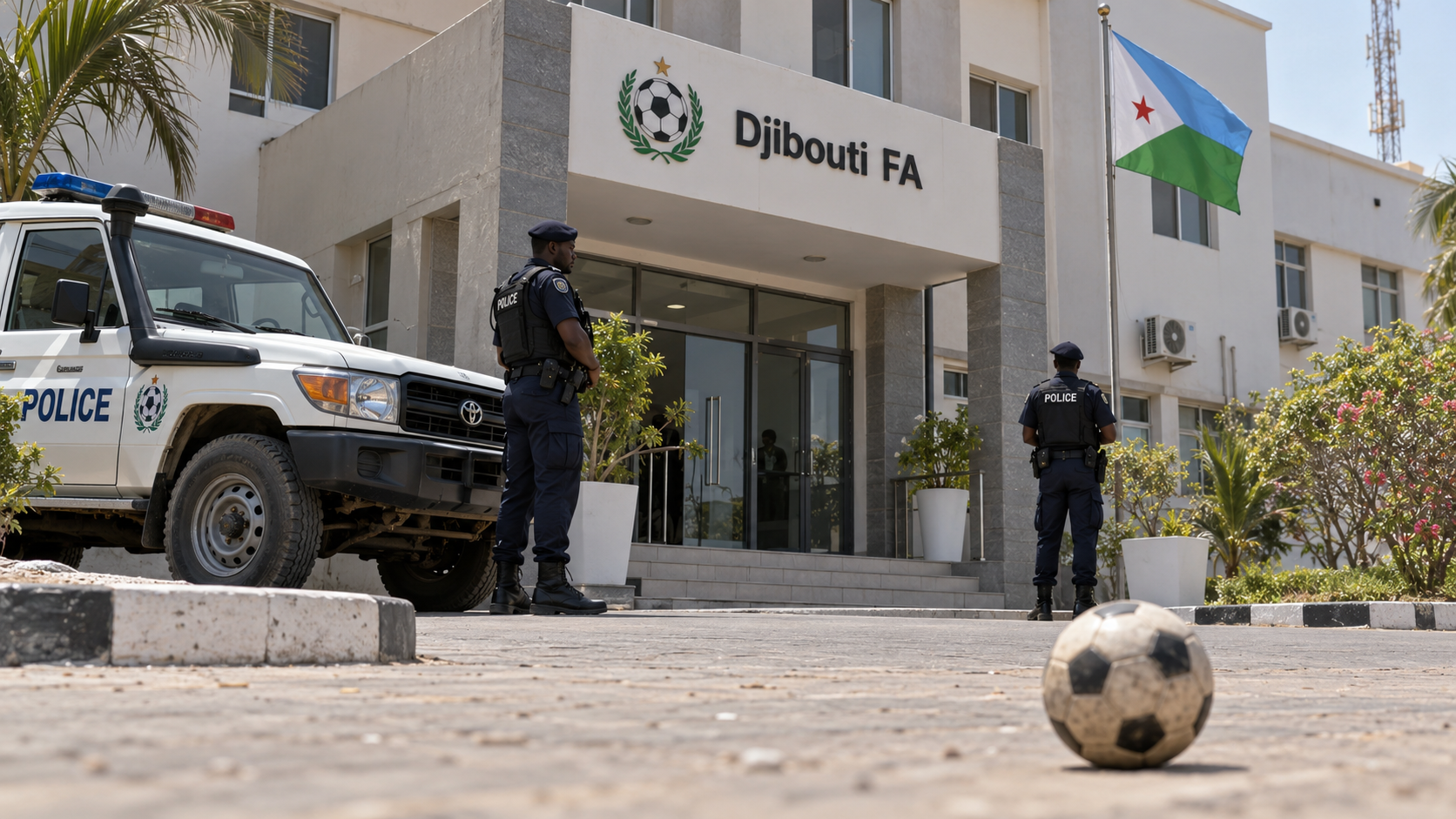
The campaign to remove Souleiman Waberi from his position as president of the Djibouti Football Federation (FDF) escalated sharply on Monday. Police took control of the federation’s headquarters after several club presidents convened an extraordinary general assembly to dismiss the Fifa council member and his executive committee.
According to the FDF, officers initially entered its national technical centre at approximately 5.30pm on Sunday without producing an administrative document or court order. A significantly larger police force returned on Monday and instructed Waberi, executive committee members, employees and other federation representatives to leave the site.
The federation said 16 club presidents were subsequently escorted into the building by police, where they conducted what the FDF called an invalid extraordinary general meeting. The FDF maintained that the gathering had not been formally arranged and that the notice requirements and procedures set out in its statutes and electoral rules were ignored. It therefore considered every resolution adopted at the meeting to be “null and void”. However, local sources claimed that the attendance threshold specified in the statutes had been met. Delegates reportedly voted unanimously to dismiss Waberi and the executive committee before appointing an interim body to manage the federation.
The dispute came after several weeks of increasing resistance to Waberi, who serves on the Confederation of African Football (Caf) executive committee and the Fifa council and is regarded as a close associate of Gianni Infantino. In early September, an alliance of 27 clubs announced plans to hold a vote on removing the executive committee, stating that it had obtained the two-thirds majority required by the federation’s statutes.
The FDF challenged that claim, arguing that its membership consists of 67 representatives and that at least 45, rather than 27, were needed to call an extraordinary assembly. Tensions grew as more clubs and delegates joined the effort to unseat the executive committee. The government later became involved when the secretary of state for sport, Fatouma Ali Abdallah, instructed the federation to arrange an extraordinary general assembly within 72 hours.
The FDF has sought assistance from Fifa and Caf, claiming that deploying state security personnel to remove elected officials may amount to government interference in the management of a national football association. It cautioned that possible repercussions could include suspension, the removal of Djiboutian clubs and national teams from international tournaments, and the withholding of development funding and programmes.
Waberi and several other officials are reportedly at risk of being charged after police completed an investigation into suspected embezzlement and money laundering involving the FDF. They were detained in September 2024 following a government audit that uncovered alleged financial and administrative problems, including deficiencies in procurement, cash handling and financial oversight. Investigators also raised questions about irregular third-party payments, unpaid taxes on salaries and wages, and the alleged improper use of cash payments worth nearly £500,000.
Waberi has rejected all allegations of misconduct. Responding in August to accusations from a club official that the federation had mishandled funds, he said Fifa’s oversight systems had found no evidence of improper activity involving the money it provided.
Fifa and Caf provide the FDF with more than $1m (£760,000) annually through a development initiative. This funding has supported football facilities and youth programmes in Djibouti, including the Douda academy and artificial playing surfaces in Arta and Dikhil. However, several related tenders are reportedly being examined over concerns that established procurement procedures were not followed.
A number of overseas workers who failed to meet immigration requirements were returned to their countries, bringing construction work to a halt. Several employees and contractors connected to Caf and Fifa described the projects in Djibouti as deeply dysfunctional. One contractor said concerns had repeatedly been reported without producing action, alleging that funds had disappeared and that projects were either left unfinished or completed only in a minimal form. The contractor added that the situation was especially damaging for young people who simply wanted opportunities to play football.
What do you feel about this post?

Like

Love

Happy

Haha

Sad