“Is there really anything fresh to add?” Gary Lineker asked producer Flora Fernandez-Marengo when she invited him to appear in The Match, a documentary about the 1986 World Cup quarter-final between England and Argentina. Speaking at the film’s London festival premiere, Flora explained that she persuaded him by revealing a 1981 photograph of Maradona with Queen during the band’s visit to Argentina. Maradona was dressed in a Union Jack T-shirt, while Freddie Mercury wore an Argentina jersey. The image convinced Lineker to participate.
The rock’n’roll connection, including commentary from Brian May, is among the few elements the filmmakers added to Andrés Burgo’s book, The Match, which inspired the documentary. Directors Juan Cabral and Santiago Franco move back and forth through time during its 91-minute running time, matching the length of the game itself. Stories that have become part of Argentinian football legend are woven together with remarkable archival footage.
“Humanity can be divided into two groups,” Jorge Valdano says, “Carlos Bilardo and everybody else.” Ricardo “El Gringo” Giusti recalls burying a sweet beneath the pitch before each game, one of the many cábalas faithfully observed by Argentina’s players under their intensely superstitious coach. Before facing England, the squad asked for lighter jerseys because their official shirts became uncomfortably heavy with sweat. Footage filmed by the players on a handheld camera shows women at the team hotel sewing numbers onto lightweight T-shirts purchased nearby. Its personal quality sharply contrasts with rough historical images of British expeditions in the South Atlantic.
Instead of presenting conventional interviews with players from both sides, the documentary films its subjects in monochrome widescreen closeups, making them resemble Roman statues. The camera holds on their faces and eyes as though they were monuments. It remains unclear what they are watching: perhaps the original match, their own memories of it, or an edited version of the documentary.
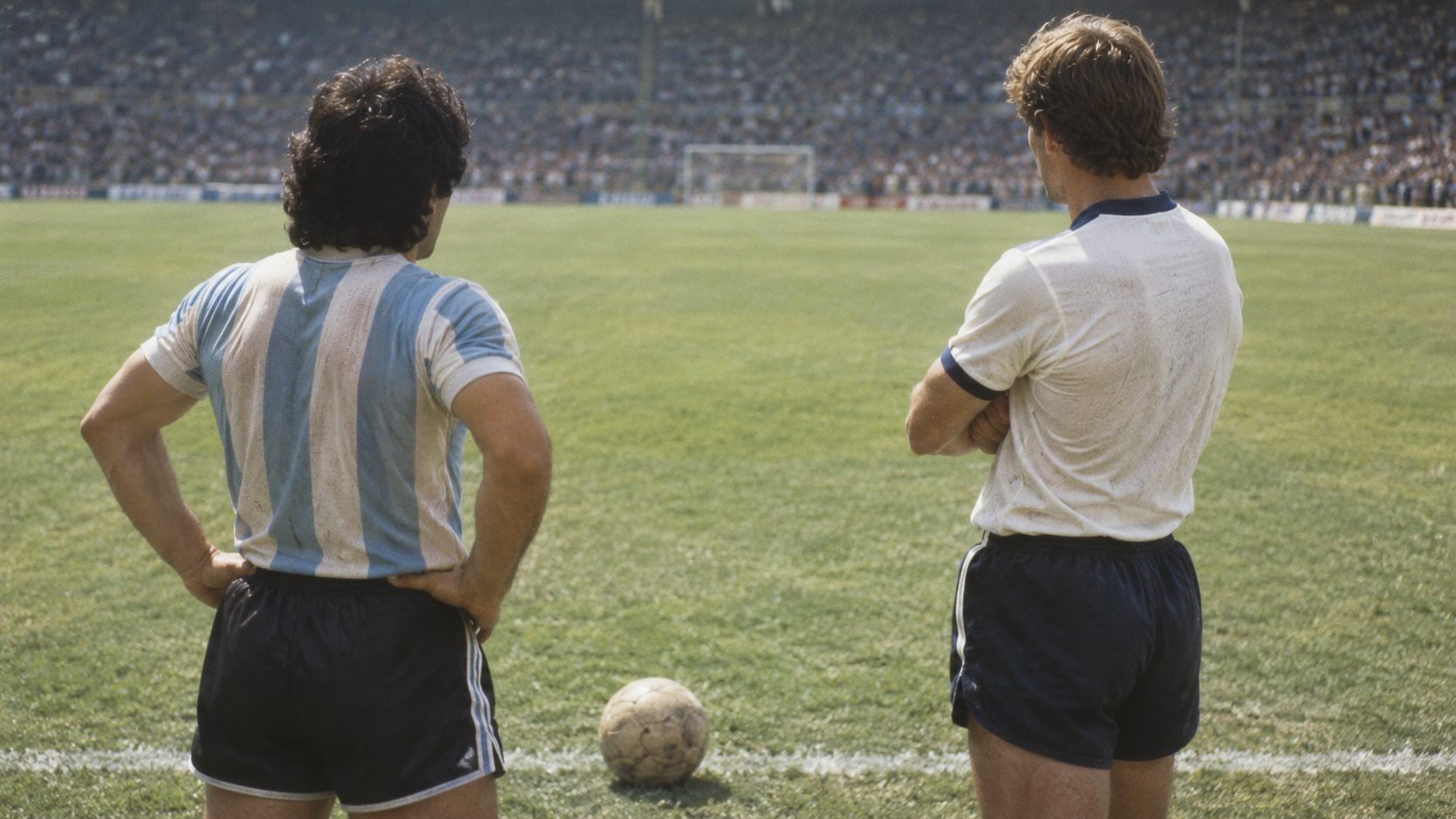
The story is built around Diego Maradona’s two goals. Over time, they have become almost impossible to regard as separate moments. Together, they capture a few extraordinary minutes in which football displayed nearly everything it can contain: a controversial handball that broke the rules, followed by a magnificent and graceful gambeta. To establish what happened during the handball, the film uses a series of photographs by Mexican photographer Alejandro Ojeda Carbajal. It also playfully acknowledges that the pictures have long been credited and licensed through English photographer Bob Thomas.
Football films are difficult to perfect because the sport already creates its own drama and storytelling. This documentary comes remarkably close. Stylish and refined, though occasionally more polished than necessary, The Match is an impressive production filled with striking imagery. One scene uses a pristine vintage radio to represent soldiers listening from the trenches. Historical news footage shows Margaret Thatcher and Argentinian military leaders during the height of the Falklands/Malvinas conflict, while the soundtrack combines Queen with major figures from Argentinian rock, including Charly García. Nostalgia, history and the shadow of war are treated with care and sensitivity.
The cruelty of Argentina’s military leadership is illustrated by footage of a severely underfed soldier paired with a general’s voice rejecting reports that troops were freezing and hungry: “They probably eat better than they did at home.” British veteran Lou Armour says he could not regard the young Argentinians as true enemies. “We both endured a tragedy,” Cabral explains. “What interests me is the contradiction in human nature that allows us to move from killing one another to embracing one another.” The director considers not only when a football match begins and finishes, but also how the same question applies to armed conflict.
Valdano reads Juan López y John Ward, Jorge Luis Borges’s poem about the war, in Spanish. Sitting beside him, Lineker responds with “very moving,” also in Spanish. Both English and Spanish are heard throughout the documentary. This includes a table football scene in which John Barnes and Peter Shilton compete against Giusti, Óscar Ruggeri and Jorge Burruchaga. Burruchaga, who scored the decisive goal in the 1986 World Cup final, encourages his rival by calling out: “Vamos, Peter!”
The documentary received a standing ovation from an audience that included many younger viewers at its London screening, where Shilton was the only participant in attendance. Its Buenos Aires release, timed to coincide with the summer World Cup, also attracted large numbers of young cinemagoers. For generations in England and Argentina who did not witness the celebrated 1986 match, much of what appears in The Match will feel entirely unfamiliar.
The Match will be shown in UK cinemas beginning on 20 November
What do you feel about this post?

Like

Love

Happy

Haha

Sad