
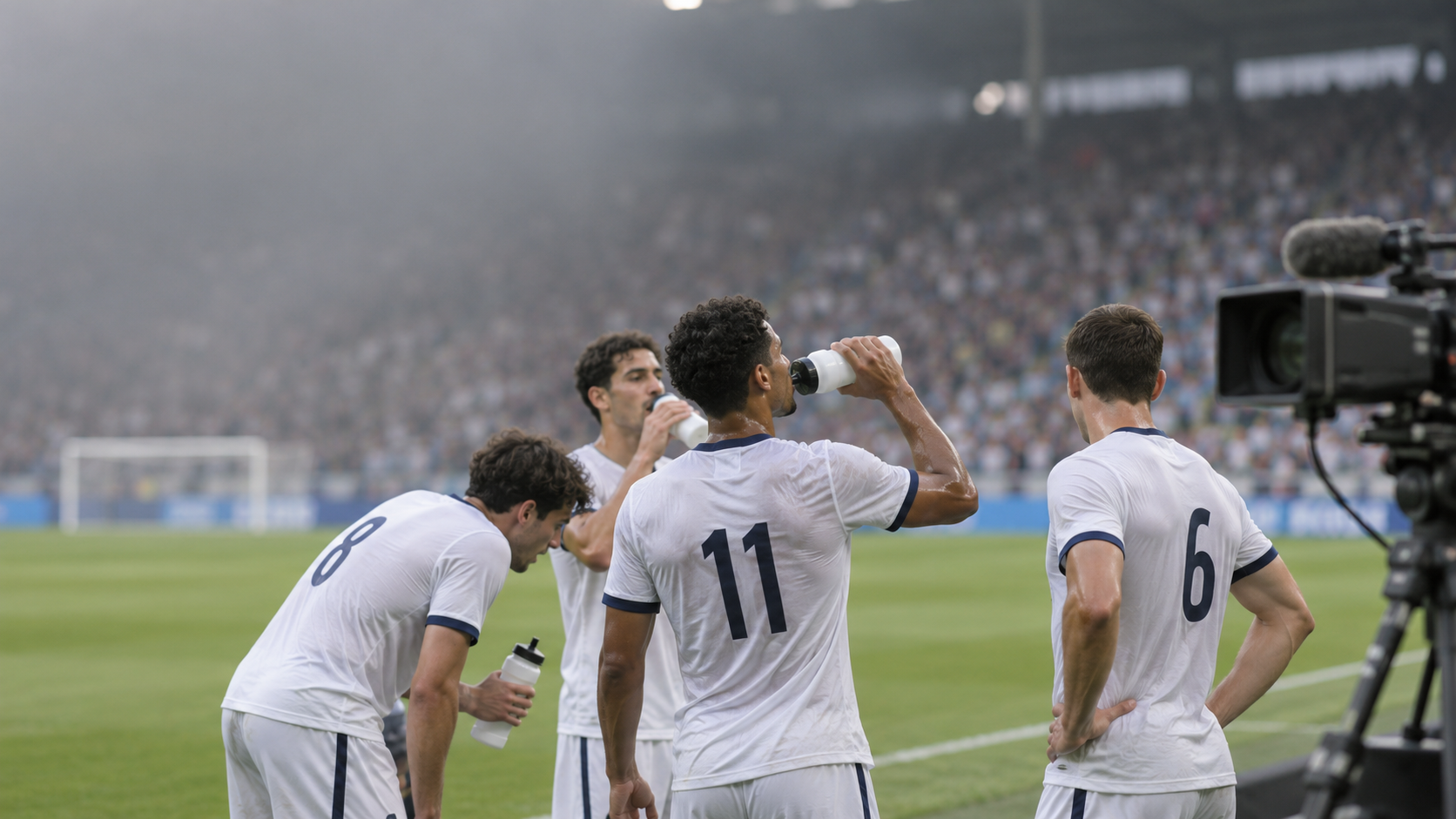
Fifa’s broadcast rights tender for the 2030 World Cup contains a clause allowing television partners to show advertisements during hydration breaks, suggesting that the debated stoppages could remain part of the tournament.
Three-minute pauses halfway through both halves were implemented across all 104 matches at last summer’s World Cup to support player welfare. The change also created valuable advertising opportunities for broadcasters, especially US rights holders Fox Sports and Telemundo.
Fifa says no final decision has been made on using hydration breaks at the 2030 competition. Most matches will be staged in Morocco, Spain and Portugal, with three fixtures taking place in South America. However, tender documents reportedly highlight both the possibility of these breaks and their commercial value to broadcasters.
Fifa has granted the Spanish World Cup rights to Netflix and the Australian rights to public broadcaster SBS. The bidding process for the United States and Puerto Rico remains open, with offers due by Thursday.
The tender documents are also believed to mention cooling breaks, a player-safety measure used by Uefa that permits matches to be paused for between 90 seconds and three minutes when the pitch-level temperature reaches 28C.
Sources close to Fifa said the tender terms were written to account for every possible arrangement.
Fifa previously introduced cooling breaks when necessary before adopting hydration breaks throughout the 2026 World Cup. The policy covers all matches even though 31 of the 104 fixtures will be held in climate-controlled stadiums. It followed the 2025 Club World Cup in the US, where extreme heat caused interruptions in roughly 60% of games.
Fifa said the decision was intended to preserve the competition’s integrity by providing consistent playing conditions in every match, although the scheduled pauses also offered broadcasters significant commercial advantages.
Industry estimates published last summer suggested that advertising shown during hydration breaks generated between $2m and $9m per match, with Fox believed to have earned approximately $250m from those slots.
Media sales analyst Guideline estimated that Fox generated $835m in total advertising revenue from the tournament, nearly twice the $485m it paid Fifa for the broadcasting rights.
Fifa received no direct financial return from the breaks last summer, but their possible inclusion in 2030 could increase the value of broadcasting packages. US rights are projected to sell for between $1.5bn (£1.14bn) and $2bn, with Netflix, other streaming platforms and traditional television companies expected to participate in the auction.
Fifa chose not to provide a statement.
Compulsory hydration breaks will not feature at next year’s Women’s World Cup in Brazil, where conditions are expected to be milder than those experienced in many host cities during last year’s men’s competition.
What do you feel about this post?

Like

Love

Happy

Haha

Sad