
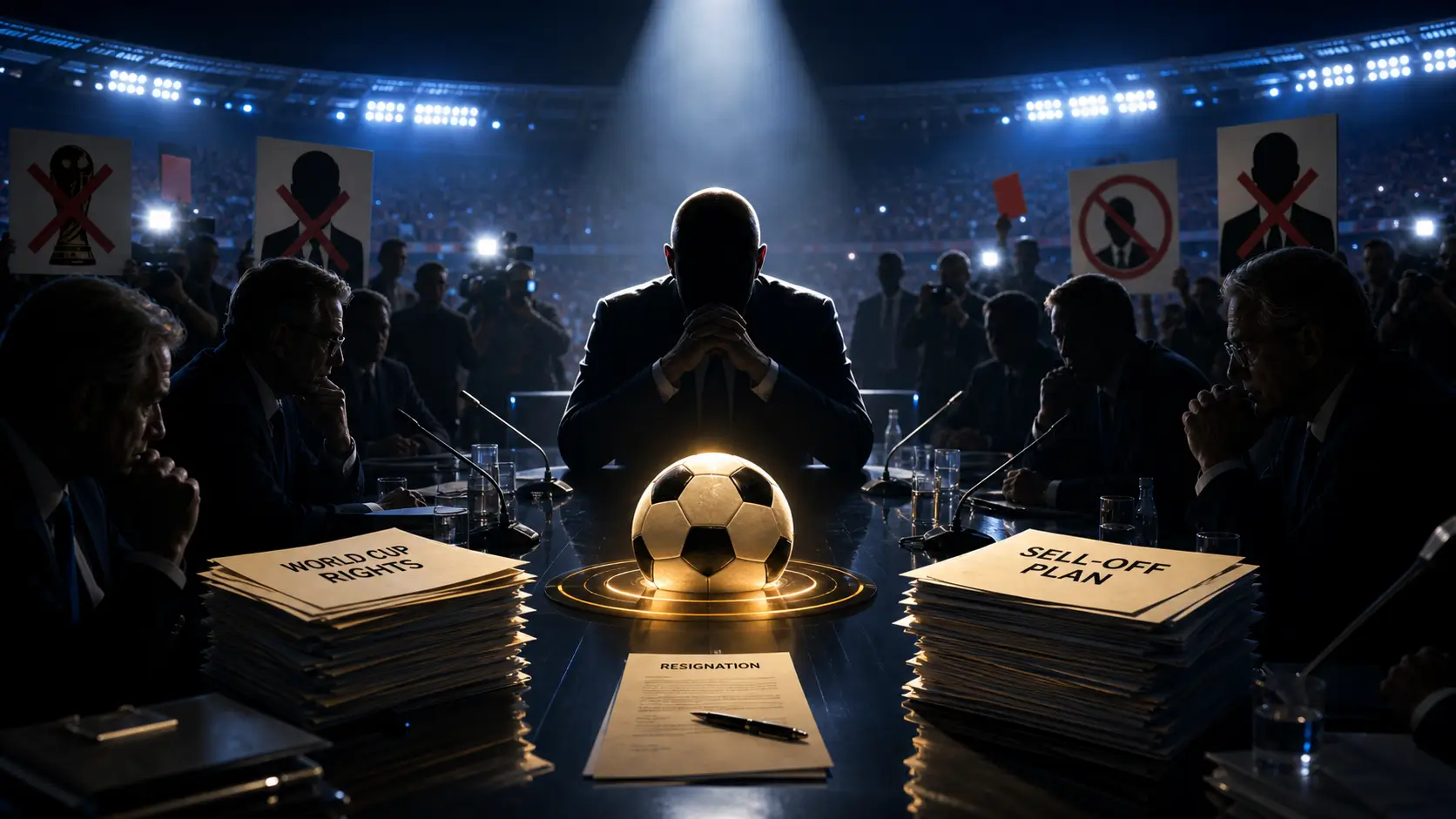
Pressure intensified around Gianni Infantino after a turbulent day in which a senior adviser stepped down and FIFA’s chief operating officer issued a severe public criticism of his leadership.
Infantino is facing growing resistance over his proposal to sell private investors stakes connected to the World Cup. European associations have warned that they could boycott FIFA tournaments unless the plan is withdrawn. Friday’s events may further weaken his position after two influential figures within his circle publicly separated themselves from the initiative.
UEFA and other regional governing bodies are also considering possible challengers for next year’s FIFA presidential election, where Infantino had previously been expected to secure a fourth term with little difficulty. The mounting backlash has raised questions about whether the Swiss official can remain in power, particularly as he continues to defend the proposal.
Carlos Cordeiro, who had served as one of Infantino’s senior advisers since 2021, resigned shortly after UEFA’s 55 members unanimously raised the possibility of a boycott. The former US Soccer president described the proposal as harmful to FIFA’s national associations, the sport itself and its long-term future. He also criticised the limited transparency surrounding the process and noted that FIFA holds substantial debt-free reserves that could instead support football development.
Cordeiro asked why the agreement was necessary, why it was being pursued now, what supervision would apply and who stood to benefit. He also questioned whether a competitive procedure had taken place, how the arrangement would be governed and what investors would ultimately receive at football’s expense.
Later that day, FIFA chief operating officer Kevin Lamour delivered an even more damaging intervention. A longtime associate of Infantino through their work at FIFA and UEFA, Lamour claimed that employees and other interested parties had been misled by the president. He added that he was prepared to lose his job for voicing those concerns.
Lamour said the recent announcements and months of activity behind closed doors were extremely difficult to comprehend. He argued that the controversial proposal did not belong to FIFA or its administration, but was instead driven by a single individual.
According to Lamour, FIFA’s vice-presidents, Council members, confederations, national associations, players, leagues, clubs and supporters had all been excluded from the process. He said the organisation’s own administrative staff had also been kept in the dark.
He described the prolonged withholding of information and the one-sided use of authority as serious warning signs. In his view, they demonstrated failures in trust, transparency, judgment, governance and respect.
Lamour said FIFA exists to serve football rather than the personal ambitions of any leader who sees himself as the organisation’s embodiment. He argued that employees should not face contempt or intimidation and said many staff members no longer appeared proud to work for the governing body.
Infantino’s support base appears to be shrinking. The Asian Football Confederation joined UEFA and Concacaf in opposing the privately financed FIFA Forward Enterprise proposal. Although the AFC did not issue the same boycott warning as UEFA, it made clear that the plan should be abandoned.
The AFC said the possibility of a World Cup boycott becoming part of public debate should alarm everyone concerned about football’s future. It concluded that the proposed enterprise was unlikely to secure the broad agreement and unity needed for implementation.
The Asian confederation also urged FIFA to conduct an immediate review of its governance and decision-making structures. Its demand reflected wider frustration over insufficient consultation on major matters, including decisions concerning World Cup hosts.
Concerns increased further after it emerged that FIFA had invited research companies to evaluate the economic impact of expanding the World Cup to 64 teams. The unusually short deadline attached to that work has caused additional unease among senior figures in the sport.
After establishing a united position against Infantino’s proposal, UEFA intends to wait and observe FIFA’s response. Initial indications suggest that the governing body is unlikely to alter its approach. FIFA has blamed news coverage for much of the opposition and has insisted that it remains committed to an open, democratic consultation, but critics have not been persuaded.
An immediate attempt to remove Infantino is considered unlikely. In principle, however, an extraordinary FIFA Congress and a confidence vote could be arranged if requested by 43 national associations. For now, opponents are focused on defeating the enterprise plan before considering additional action. Any UEFA-supported candidate in the March presidential election would probably come from outside Europe. Possible contenders include Concacaf president Victor Montagliani and AFC president Sheikh Salman bin Ebrahim al-Khalifa, who narrowly lost to Infantino in 2016.
FIFA is continuing to encourage national associations to support the proposal and has retained the original 19 September deadline for those wishing to participate.
What do you feel about this post?

Like

Love

Happy

Haha

Sad