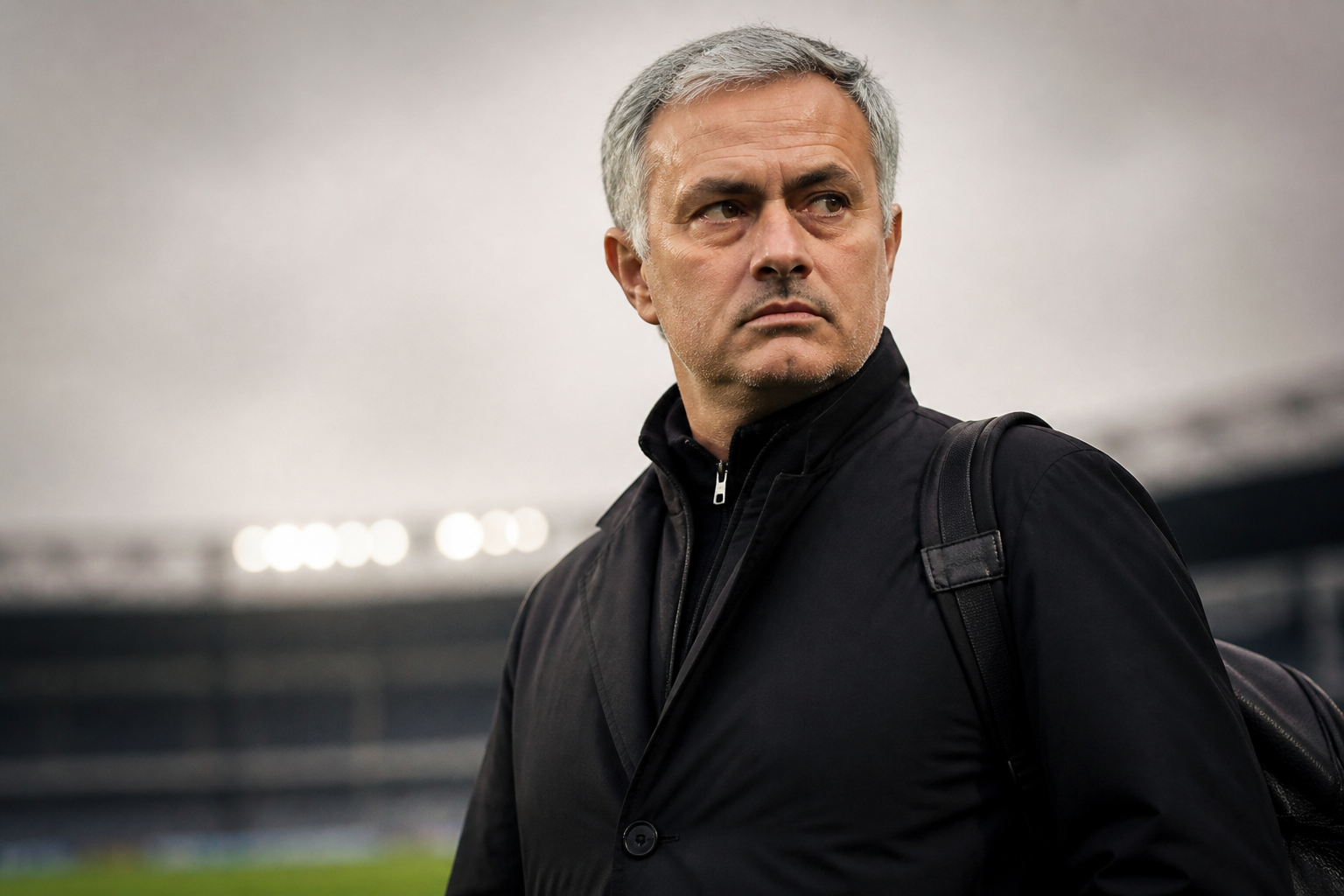
Even within football’s already exaggerated universe, few figures are as fascinating, divisive, or impossible to ignore as José Mourinho. His most admirable and troubling qualities are fully exposed in a new three-part streaming documentary. “It reminded me of how talented he was,” says director Joe Pearlman, while Mourinho himself seems determined to make the same point. As he says in the series: “I look, you look, I see more than you.”
Yet documentary-making often means guiding people toward the subjects they are most determined to avoid. “I knew the interviews would be extremely intense,” Pearlman says, “and that he would try to steer the story and manipulate us. In his version of events, every failure belongs to someone else, while everything he has achieved is justified by victory. Because, to him, that is the only thing that matters.”
That is only one part of Mourinho’s distinctive perspective. “In the third episode, I ask him about his childhood,” Pearlman explains, “but he refuses to discuss it because he doesn’t believe it has any bearing on the person he became. In effect, he says he isn’t interested in people. That is a strange position for someone regarded as one of the greatest managers of people in history.”
Mourinho grew up as the son of a popular coach and felt like an outsider because much of his identity was linked to his father. Later, when he entered management without having enjoyed a significant playing career, that outsider status seemed to give him a special form of authority. This belief in himself clearly helped him build his own destiny, whether surrounded by enormous success at Chelsea or working in Madrid. It reflects the mindset of someone who has carried a grievance for much of his life, strengthened by his natural magnetism and exceptional tactical intelligence.
Félix Mourinho died in June 2017, and the documentary shows the emotion that still surrounds the subject. “He has clearly pushed his father’s death deep inside,” Pearlman says. “It is incredibly difficult for him to discuss. I lost my mother, but I can speak about her openly because I have worked through that grief. I have had therapy and tried to understand what that period of my life means. I don’t think José has ever made that kind of effort with any part of his own story. He is constantly looking ahead and searching for the next challenge. He may be celebrating a treble with Inter after defeating Louis van Gaal and Bayern, but part of his mind is already focused on overcoming Guardiola when he moves to Madrid.”
“His father’s death altered him, and the years that followed were marked by that loss. José also holds on to every comment, every goal, and every decision that goes against him. It is as if he has been carrying a heavy bag filled with pain since he was around 19 or 20.”
Even so, the qualities that make Mourinho extraordinary – his humour, perception, self-belief, energy, charm, brilliance, and composure – radiate from the screen. “He needed somewhere to express the fullest possible version of himself, and football gave him that opportunity,” Pearlman says. “His ego and charisma, combined with his ability, allowed him to become the figure he had always imagined. Perhaps he was not that person during childhood, but it is the identity audiences have come to associate with José Mourinho.”
That identity is, naturally, only one interpretation of the man: a persona refined for football’s battles. He appears to regard the sport as separate from ordinary life, a battlefield where almost anything can be excused if it helps deliver victory. His controversial treatment of Anders Frisk and Eva Carneiro is no more apologetic today than it was at the time. At the same time, Mourinho speaks about wanting to be loved, although it can sometimes seem that he values public adoration as much as genuine affection. “It may also mean, ‘I want everyone’s attention focused on me,’” Pearlman says. “Conflict provides that in abundance. It becomes a kind of protective shield that lets him believe he is fighting for a morally justified purpose.”
Away from football, Mourinho presents a quieter and more restrained figure. His family life provides another painful moment in the series, as he admits that long absences have become so normal that his family may find it easier when he is not there. “You can hear the reaction in my voice,” Pearlman says. “I was thinking, ‘My goodness, what must it feel like to say that out loud?’”
What does Pearlman believe the series is really about? “A large part concerns the idea of winning regardless of the cost,” he says, “and the consequences of being defined by success once that success disappears. It is also a study of a hero and a villain, and of one of the most powerful leaders of people the world has ever witnessed. We should probably be grateful that Mourinho never entered politics.”
The story now appears to have an unexpectedly positive conclusion, with Mourinho returning to Madrid. “During the past few years, from Roma to Benfica and beyond, I don’t think I could honestly say I had encountered a genuinely happy or satisfied man,” Pearlman says. “Now he is in the place where he feels he was always meant to be. After every major trophy the club has won since his departure, Florentino Pérez has contacted him to say, ‘This happened because of you,’ referring to the changes he brought to the team. One thing is certain: whatever he does next is likely to become a major spectacle.”
Mourinho is available on Netflix
What do you feel about this post?

Like

Love

Happy

Haha

Sad