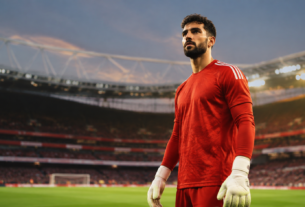
Bellingham versus the elements. Throughout most of the match, it seemed as though three distinct forces were vying for dominance in the thick Miami Gardens atmosphere. Norway, appearing in their maiden World Cup last-eight tie, exhibited spirit, technique, and composure, and by any measure excluding Bellingham’s impact, they were arguably the superior side.
At the same time, stepping into the spotlight, was the sweltering July heat of Florida, an air so dense it wraps around you like an unseen thick cream, blurring your sight and dulling your mind, conditions to which England appeared especially susceptible.
For extended stretches, they didn’t just look disorganized and bewildered, but completely exhausted, dangling like a row of dried-out white jerseys on a clothesline in the marshland.
People aren’t exactly meant to be in this environment. Miami is essentially a concealed marshland, a metropolis perched on a delicate layer of congestion, asphalt, and fried fish batter. Opposite Miami Stadium lies a manicured mall pond where enormous lizards, as big as greyhounds, scuttle into the undergrowth as you approach and then glance back, not aggressively, but with bewilderment, as if to ask: ‘Why are you here, really? Have you taken a good look at this place?’
Locals in Florida continually fight against ‘corrosion’, the word for how the atmosphere attacks all surfaces, a relentless barrage of moisture, mold, and distortion. And that corrosion overcame England in this match. To give them credit, they finished strongly and began with determination. Yet in the middle, they were subpar for large portions, devoid of cunning and ill at ease, with numerous players wilting under the pressure of the moment.
Occasionally, this evoked the all-too-recognizable England spectacle of hollow figures, stuffed shirts, passively letting the match unfold around them, football as a gradual asphyxiation in that heavy, cloying air. However, they possessed Jude Bellingham, who increasingly appears to be a wholly different species within this squad, contesting his own separate championship, one that has so far carried the rest along on its coattails.
Right from the start, it was evident that Bellingham’s mission was not merely to impose himself on the opponents, or even combat the chaos within his own side, but to become the protagonist in that tripartite struggle with the environment, a lone figure fighting the atmosphere, physically dominating the sun itself.
Jude Bellingham capitalizes on a mistake to net England’s decisive goal against Norway. Photograph: Chandan Khanna/AFP/Getty Images
Ultimately, he scored both goals in England’s 2-1 victory across 120 minutes, each a sliding, full-bodied finish. Throughout, he simply refused to accept defeat, injecting surges of vigor and direction into his fading colleagues.
Both of Bellingham’s strikes arrived when Norway appeared to be in control and England were slipping away. The clearest instance was when trailing 1-0, with halftime approaching, after England had wasted a lengthy spell of sterile possession, a team succumbing to the elements.
The leveller marked England’s first attempt on goal. It originated from Bellingham’s signature diagonal burst from right to left, the pass delivered crisply by Elliot Anderson, as Norway appeared to freeze, an invisible force field parting around that solitary white jersey, granting Bellingham the time to steady himself and unleash a surprisingly powerful strike past Ørjan Håskjold Nyland into the distant corner.
double quotation markEveryone has a strategy until Bellingham intervenes. England’s number 10 has now netted six goals at this World Cup
On the sidelines, Ståle Solbakken exploded with an untypical burst of anger. Throughout this World Cup, it has often seemed that Bellingham’s driving run is England’s sole method of cracking a match open, their lone unpredictable component in a contest of rigid patterns. Norway’s coaching staff will have devoted countless hours to dissecting it, watching replays on the large monitor. Everyone has a blueprint until Bellingham dismantles it.
England’s number 10 has tallied six goals in the tournament and has been the overwhelming influence in a side that keeps unravelling as it goes. He stays the sole England footballer with the assurance and ability to dribble past an opponent, to improvise on the fly, and to take clever risks with his positioning and distribution.
To draw the inevitable parallels—the Maradona-like solo World Cup campaign, the sovereign of the sun, the blade of athletic fate—would be misguided. Such feats don’t occur in teams this imperfect. England were salvaged in this match, not repaired.
Until now, the right-back slot had been akin to the Spinal Tap drummer’s seat, with its incumbents perpetually falling by the wayside. In this match, it was the central midfield, Bellingham’s domain, that crumbled as the game unfolded. He appeared to sense it approaching, dashing back to the centre spot after netting the equalizer, then bolting down the tunnel ahead of everyone at the interval, a man driven by an urge to simply run, to cleave through the atmosphere.
Miami Stadium, the venue for the NFL’s Dolphins, is a vast, towering hangar with a suspended tubular canopy. At five o’clock on a peak summer Florida afternoon, it formed an immense, sweltering chamber of heat and sound. At kick-off, red and white were everywhere, the terraces decked with flags from the customary whistle-stop tour of the country—from Grimsby to Portsmouth to Bury—evoking a John Betjeman verse on the bittersweet decay of the English market town.
England started with a phase of deliberate possession, then gradually faded. There were flashes, a few neat twists and glides by Bellingham, and openings wide, but in particular Noni Madueke lacked accuracy. During that spell, England’s shortcomings were on display: a shortage of ingenuity, an incapacity to unlock a tightly compressed double block.
Sign up to The Daily Football
Start your evenings with our take on the global football scene
The water break came with England holding 71% possession, triple the number of passes, and no attempts on goal. Then, in the 35th minute, Norway claimed the lead, a fair reflection of the match’s flow. The ball was shifted left to Andreas Schjelderup, whose mishit cross transformed into an exquisite dipping strike that nestled in the top corner. Jordan Pickford also misread it, apparently believing it was sailing wide.
Apart from that, for England this was the day the midfield disintegrated, the central axis grinding along the road for the final hour, shedding sparks. Anderson, too, was outstanding, out of necessity, chasing and contesting every ball, covering twice the ground. By full time, Anderson had run himself into a shell, reduced to bone, parchment, and dried crackers inside his white jersey, a player who will now be coughing up grit for the next 48 hours.
England players celebrate with their fans after clinching a World Cup semi-final berth. Photograph: Mike Segar/Reuters
Over the course of 120 minutes, the central midfield partnership morphed from Declan Rice and Anderson, to Bellingham and Anderson, to Reece James and Anderson, to Morgan Rogers and Anderson. Notably absent was Kobbie Mainoo, who presumably ranks behind David Beckham, a training cone, a giant lizard, and a television cable in the pecking order for a place. Why is Mainoo even in the squad? Why isn’t Adam Wharton? These are questions that demand a proper response.
Thomas Tuchel watched on in his signature black shirt, silky black trousers, and white sneakers, suggesting an undertaker at the seaside. Yet, at moments you questioned whether the heat was also affecting his mind, whirring and buzzing like an overwhelmed AC unit. His crucial error was shifting Bellingham into central midfield after Declan Rice was withdrawn due to illness at halftime. At that juncture, Bellingham was already dominating the narrative of the match.
Abruptly, the momentum changed. England looked extremely exposed at times. Norway retained possession and circulated it more smoothly than England managed during their own dominant phases, laying bare the lack of off-the-ball movement and elementary finesse in England’s play.
Tuchel eventually remedied the situation. His final midfield gamble was introducing Rogers, a substitution that synced with England regaining command as Norway fatigued and Erling Haaland trudged off. Rogers’ attempt on goal produced the winner, with Bellingham once more the sole moving entity amid that dense, oppressive air, as Nyland spilled the ball directly into his stride.
And so England clung on. Bellingham departed with 110 minutes elapsed, to a thunderous ovation, substituted by the defensive finisher Dan Burn, who rumbled on like a cluster of tiny men stacked beneath an overcoat, and settled into a reassuringly solid five-man backline.
England will now journey to Atlanta for a semifinal. It is a considerable achievement, especially given how much they need to mend, conveying the feeling of a team that has advanced on sheer emotion, fury, and isolated bursts of genius from the player in the No 10 jersey, who is contesting his own magnificent, separate World Cup.
Bellingham cannot secure this title for England single-handedly. France and Spain also possess outstanding players, operating within well-functioning team frameworks. But that concern can be postponed. Norway, Miami, and a quarterfinal where even the air appeared to be dragging them down by the ankles can remain as its own moment of glory.
What do you feel about this post?

Like

Love

Happy

Haha

Sad