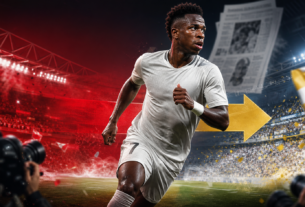
Appearing on football’s biggest platform for perhaps the final time, Lionel Messi looked poised to deliver one last iconic moment in this tournament decider.
But as the sun slipped below the west stand at New York New Jersey Stadium on Sunday, it grew increasingly apparent that Argentina had lost the spark that had carried them through the event. As Spain steadily took charge, an unavoidable truth set in: Messi and his team had ultimately run out of time, having already surrendered to their worst tendencies in a 1-0 loss.
The decider stood in sharp opposition to the Argentina—and Messi—seen in every prior match of the tournament. Almost without fail, La Albiceleste had been the most captivating side, less because of how they found the net and more for when they did so, delivering a textbook display of dramatic timing. On two occasions they came within a whisker of elimination against clearly overmatched opponents, outcomes that only spurred them forward.
Title matches often prove forgettable and short on entertainment, yet even by that modest benchmark the flow of play here felt abysmal. Spain were stifling on defense and—following a first half devoid of incident—gradually found their rhythm in the second, eventually and predictably striking in extra time. Argentina? They became the first side in the nearly hundred-year history of the championship to fail to register a single shot during the regulation 90 minutes of a final. Even with an extra half hour granted, they posed virtually no danger.
As for Messi? Before this final, he had offered viewers one of the rarest sights in elite sport: a window into greatness without consequences, completely unburdened by any real expectation. At 39, Messi has nothing left to prove, and no one can question his array of trophies—earned individually, with club, or with country. This loss does nothing to stain a flawless legacy; a victory would only have bolstered his case as the sport’s greatest ever. For some Argentinians, the semifinal triumph over England probably already carries nearly as much significance as a final win might have.
Still, it must be acknowledged: Messi was largely a peripheral figure in this match, a far departure from the player who has occasionally lifted his team through this summer. Much of that is undoubtedly attributed to a defensive masterclass from Spain. That alone doesn’t always suffice to shackle the diminutive Argentina captain. Yet credit where it’s due: Spain outclassed Argentina in every aspect, rendering even Messi ineffective. By the end, Argentina had become the very thing many observers—sometimes unfairly—had originally pegged them to be: cynical, combative, and at their wits’ end.
Time has rarely ever mattered to Messi on the pitch, because he so often warps it at will to slip away from his markers. The way he performs at age 39 achieves a comparable effect, ripping open a gap in time and carrying fans back to his peak years at Barcelona and beyond. Time hasn’t so much left him behind as he has kept in lockstep with it, occasionally lagging by a half step but always inevitably drawing level again.
Now, however, we confront the inescapable fact that Messi’s World Cup journey is over—this was, notably, the same sentiment expressed after he guided Argentina to their first title in almost forty years in 2022, and what was presumed in 2016 when Messi briefly stepped away from the national side following a Copa América final defeat. Back then, the prevailing narrative was that he would never replicate his Barcelona performances for Argentina, or even murmurs that he wasn’t sufficiently Argentine, having lived most of his life in Spain. A decade on, both notions seem utterly absurd.
It remains uncertain how Argentina’s showing will be judged at home, where expectations were justifiably lofty. Head coach Lionel Scaloni, along with Messi, had repeatedly emphasized before the final just how much they had already attained. This final outcome, they suggested, would scarcely diminish their sense of achievement.
That was, of course, before they took to the pitch and more or less unraveled the contest. Scaloni’s standing, like Messi’s, was firmly established ahead of this final—the manager having delivered a third world title and two Copa América trophies—but this represented a squandered chance to cement it further. Two realities can exist side by side: Scaloni is arguably Argentina’s finest-ever coach, and this was among his worst outcomes and displays.
What lingers much more palpably, however, is a feeling of emptiness and disillusionment following this wretched final showing, which had handed Argentina—and Messi—an ideal shot at putting a storybook finish on their fairy tale. Instead, they morphed from protagonists to antagonists—needlessly so.
What do you feel about this post?

Like

Love

Happy

Haha

Sad