
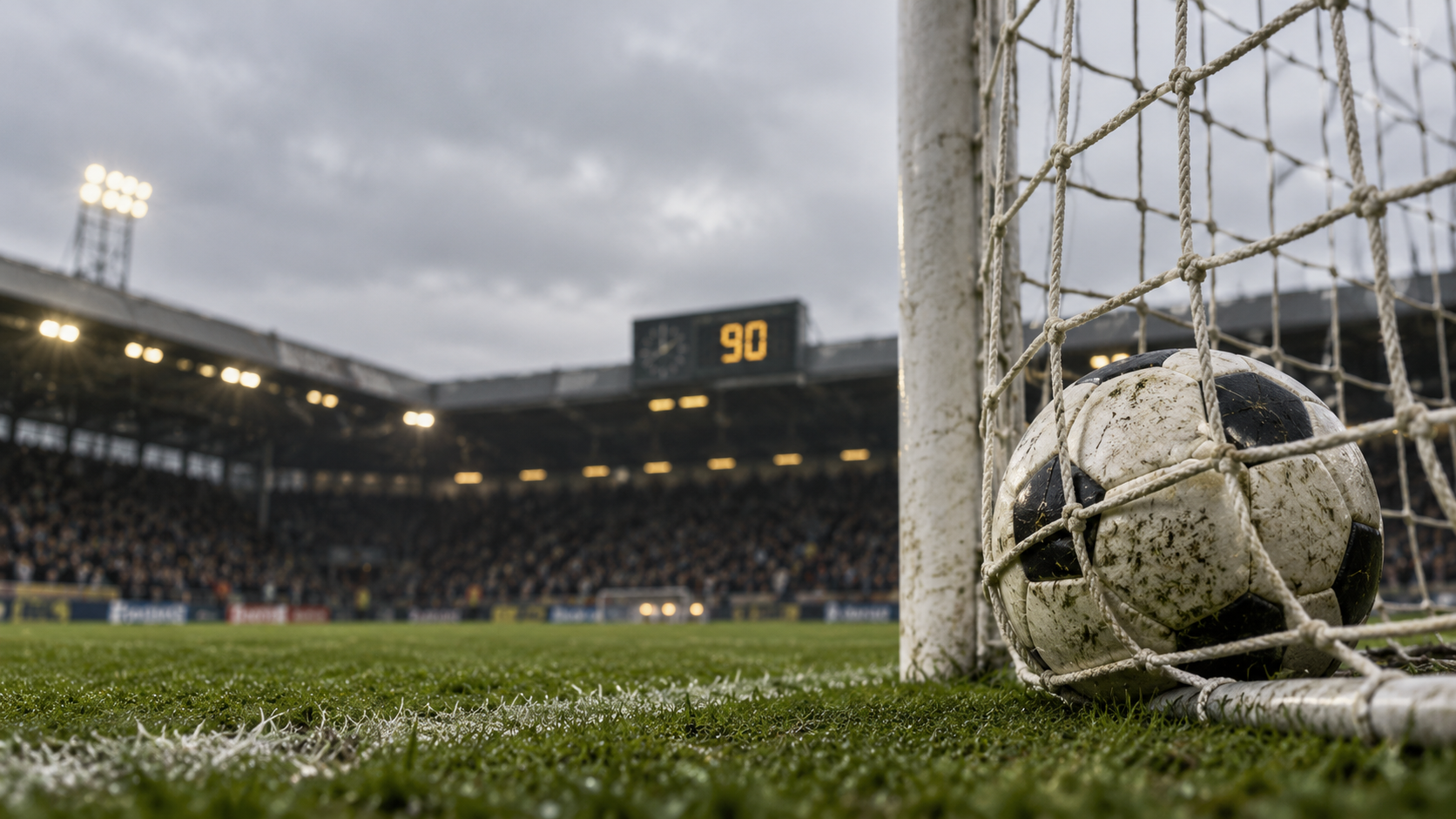
“Justin Seven-Seven entered the match in the 75th minute and found the net two minutes later for West Brom Under-21s against Sutton United in the National League Cup. The obvious question is: has another player scored in a minute matching their name?” asks Peter Skilton.
Older supporters may remember Didier Six, the gifted but unpredictable French winger who spent a short period with Aston Villa in 1984-85. Several readers identified some or all of these goals scored in the sixth minute, including strikes against Bordeaux in successive seasons:
-
Valenciennes 2-1 Nancy (agg: 2-3) Coupe de France quarter-final, 1975-76
-
Valenciennes 3-2 Bordeaux Ligue 1, 1976-77
-
Lens 2-0 Bordeaux Ligue 1, 1977-78
-
VfB Stuttgart 5-1 Karlsruher Bundesliga, 1981-82
Alphonse Six, who represented Belgium nine times and scored prolifically at club level before dying at the age of 24 during the first world war, may also have struck in the sixth minute. However, precise scoring times from club matches in the 1910s are difficult to locate. Pete Tomlin adds that Austrian forward Martin Six achieved the feat while representing SV Allerheiligen against DSV Leoben in the Regional League Central on 1 April 2011.
Richard Wilson notes that Scottish lower-league regular Armand Oné scored for Stranraer in the opening minute of a League Two match against East Stirlingshire in 2010-11. His son Ryan, now with Sheffield United, has yet to repeat the achievement but still has time to do so.
The idea also works in languages other than English, as Filippo Varanini observes. A researcher discovered a 1998 Serie C match in which Raffaele Quaranta, whose surname translates as 40, scored for Casarano in the 40th minute. Pete also highlights Swiss midfielder Claude Sixt. Although his surname is not an exact match for the number, he scored for Sion against Urania Genève in the 60th minute of a Swiss League game on 28 May 1966. Marculino Ninte provides another example, having struck in the 90th minute for CD Mafra against SU 1° Dezembro in Portugal’s third tier on 5 October 2025.
Mark Johnson supplies a playful final example. On 2 August 2003, Marek Heinz, in a nod to the famous 57 varieties slogan, scored in the 57th minute when Banik Ostrava faced Slovan Liberec.
Claret and blue droughts
“Burnley have completed an entire calendar year without winning a home league match. What is the longest home winless spell, either in league football or across all competitions?” asks Niall McVeigh.
Burnley defeated Millwall in the FA Cup in January, but their most recent league victory at Turf Moor came 376 days ago, when they beat Leeds 2-0 on 18 October 2025. Even longer waits have occurred elsewhere.
Dave Mellinger points out that NWSL side Sky Blue FC, now known as Gotham FC, failed to record a home victory from 26 August 2017 until 8 September 2018, a run lasting 378 days. They finally defeated Orlando Pride in their last match of the 2018 campaign, securing their only win of the season at any venue. Without that result, the sequence would have continued until the following campaign began in April 2019.
Reggiana endured an even longer spell in Italy three decades ago. Despite collecting two away victories during 1996-97, they failed to win at Stadio Giglio throughout the entire season, including cup fixtures. Their previous home success came in the final home match of 1995-96, while their next arrived in the opening home fixture of 1997-98. The barren period stretched from 23 May 1996 to 30 August 1997, an extraordinary 465 days.
Reaching 100 goals before Christmas
“By my calculation, Ross County have already registered 81 goals this season: 38 across 10 league fixtures, including 8-0 and 7-1 victories over Queen of the South, another 30 in six Challenge Cup group matches and 13 in six League Cup games. They could reach 100 before October ends. Has any team completed a century earlier in a season?” asks Stephen James.
A recent example offers a useful comparison before considering an older pre-Christmas achievement. Last season, Vincent Kompany’s Bayern Munich passed 100 goals during a 5-1 victory at Leipzig on 17 January. Their total was distributed as follows:
-
Bundesliga 71 goals from 18 matches
-
Champions League 18 goals from 6 matches
-
DFB-Pokal 10 goals from 3 matches
-
Franz Beckenbauer Supercup 2 goals from 1 match
The Turnbull Tornadoes, the nickname given to Eddie Turnbull’s Hibernian team of the early 1970s, reached the landmark a month sooner. Mark Shipway explains that Hibernian scored their 100th goal of the 1972-73 season on 16 December during an 8-1 win against Ayr United. By that point, they had accumulated 41 league goals in 14 matches, 12 in three Drybrough Cup ties, 32 in 12 League Cup fixtures and 15 across four European Cup Winners’ Cup games.
Hibernian required 33 matches compared with Bayern’s 28, although the original question concerns the date rather than the number of games. Alan Gordon, Jimmy O’Rourke and Arthur Duncan were their equivalents of Harry Kane, Michael Olise and Luis Díaz, combining for 98 goals over the full campaign.
Six of those goals came in the celebrated 7-0 victory away to Hearts on 1 January. Curiously, Hibernian’s scoring faded dramatically near the end of the season. Beginning with a Cup Winners’ Cup quarter-final loss to Hajduk Split, they managed only two goals in their final eight matches.
From the football records
“Which football club was the first to operate an official website?” Chris White asked in 2016. “What about the earliest unofficial site? TWTD, an independent Ipswich Town supporters’ site, has existed since 1995 and must be among the oldest. Which clubs were also the earliest adopters of social media?”
Martyn Amos offered some first-hand information. He said Ipswich Town had the earliest club website, whether official or unofficial, and that he had once helped maintain it. Phil Clarke, who worked for BT in Martlesham near Ipswich, established the site in 1990 while the web remained experimental. Between 1993 and 1995, responsibility passed to Paul Felton, then a student at UEA in Norwich.
After Felton graduated, Amos took charge while studying for a PhD at Warwick in 1995-96. Felton resumed control in 1996 and continued running the site until 2001, when the club recognised the web’s potential and appointed a local company, AWS, to manage it. Sheffield United supporters also disputed Ipswich’s claim to being first, but Amos believes the matter was eventually settled in Ipswich’s favour.
For independent sites, Peter Sorrill suggests Reading’s Hob Nob Anyone, which dates from November 1994. He notes that the boundary between official and unofficial pages was unclear in the early 1990s because many clubs had little technological expertise. A 2014 anniversary report recounts founder Graham Loader’s discovery of the internet while studying computing. He initially underestimated its potential, but the site grew quickly as supporters expressed their excitement at accessing Reading news from countries such as Canada and Australia.
Alex Lopez-Ortiz identified a potentially earlier example. The NCSA “What’s New” page from September 1993 announced that online information about Sheffield Wednesday Football Club was available through a website at Nottingham University. This appeared exceptionally early in the web’s development, only months after NCSA Mosaic, the browser credited with helping popularise the medium, launched in January 1993.
Questions for readers
Matthew Wilkie asks whether Bournemouth’s 3-0 victory over Milan produced a unique occurrence: two first-half penalties converted by different players against different goalkeepers. He also wants to know the record, excluding shootouts, for the most penalties scored by one team in a single match with each taken by a different player.
Dave Smythe asks for the shortest period between a manager signing a contract extension and subsequently being dismissed.
Gordon Smith wonders who became the first manager to watch his team while wearing a tracksuit. He recalls Sir Alf Ramsey doing so during England matches and asks whether Ramsey had already adopted that clothing while managing Ipswich.
Mark Reilly notes that Newcastle faced Hull at 3pm on Saturday 19 September and are scheduled to meet Fulham at the same time on 7 November, while their other fixtures have not used the traditional slot. None of the currently arranged matches through 7 January, including the game against Manchester United, will begin at 3pm on a Saturday. He asks for the fewest Saturday 3pm kick-offs played by one club during a Premier League season.
What do you feel about this post?

Like

Love

Happy

Haha

Sad