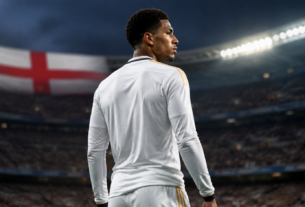
Ezri Konsa: The Aston Villa centre-back appeared in every fixture and once again demonstrated his capability at the highest level of the international game. Deployed primarily as a central defender, he also slotted in on the right side of defence during the quarter-final victory over Norway. Capped off his tournament by finding the net in the third-place match. 7
John Stones: Selecting Stones was viewed as a risk by Thomas Tuchel given the defender’s recent struggles to stay fit. He lined up for the opening contest, endured a few uncertain passages, and then sat out the following two matches. However, he rallied to reclaim his place for the quarter-final success against Norway and the semi-final loss to Argentina. The 32-year-old displayed his class but was beaten in the air for Lautaro Martinez’s decisive strike. 7
Marc Guehi: A reliable presence in England’s rearguard at major competitions. Guehi was omitted from the starting lineup in the opener against Croatia, but once introduced he exhibited his trademark composure and ability. He delivered a standout display against his club colleague Erling Haaland in the last-eight clash with Norway and maintained a high level right up until England’s elimination. 8
Trevoh Chalobah: The Chelsea centre-back received a late summons to replace Tino Livramento. The call-up sparked considerable discussion, with many feeling it left the squad light in the full-back positions. Chalobah appeared only in the final moments of the victory over France, his sole action across the entire campaign. 5
Jarell Quansah: This marked Quansah’s debut at a major international event, and his inclusion in the 26-player group came as something of a surprise. Yet the Bayer Leverkusen defender justified Tuchel’s desire to have him available as an option in the full-back role. Quansah began brightly against Panama before suffering an injury, then did the same against Mexico prior to receiving a red card. He returned for the bronze-medal match and looks set for a lengthy international career. 6
Dan Burn: The Newcastle defender’s selection prompted plenty of scrutiny, but his display against Mexico underscored the logic behind it. Burn’s dominance in the air offered England a method to close out contests, though Tuchel resorted to that approach prematurely when attempting to protect a lead against Argentina. 6.5
Nico O’Reilly: The 21-year-old featured in his first major competition and improved as it progressed following a tense opening appearance. O’Reilly only secured the role of first-choice left-back in November, so to step from there into a World Cup and start five of eight encounters is a remarkable achievement. He is extremely comfortable in possession but still has work to do on the defensive side. 6.5
Reece James: The Chelsea skipper described the ongoing scrutiny of his fitness as “tedious,” yet the primary right-back was sidelined for three matches after picking up a hamstring problem against Ghana. He regained fitness in time to feature in both the quarter-final and semi-final, where he underlined his undoubted talent. 6.5
Djed Spence: The Tottenham full-back emerged as one of England’s revelations during the tournament. Spence’s versatility to operate on either flank is hugely beneficial in a tournament setting. He excels in one-on-one defensive situations and his speed provides the side with an attacking outlet. He produced two of his finest displays in the quarter-final and semi-final. Spence also impressed against France, where he earned a spot-kick. 8
What do you feel about this post?

Like

Love

Happy

Haha

Sad