
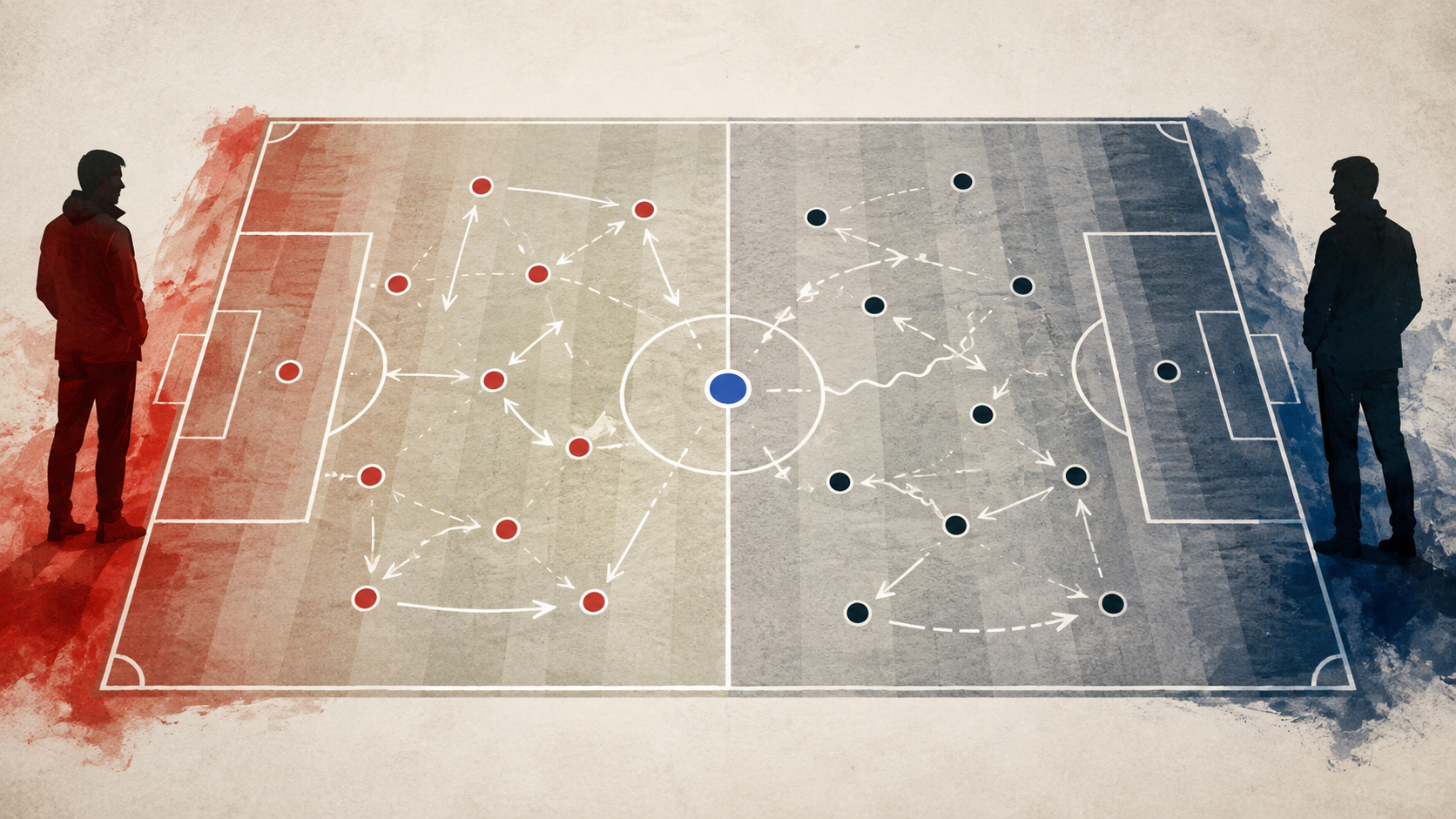
Control against chaos. One side represents structure, discipline and carefully rehearsed patterns; the other embraces something more instinctive, accepting football’s flaws and unpredictability. From that perspective, it is wiser to move with the storm than to imagine it can ever be fully contained.
That was how the rivalry between Pep Guardiola and Jürgen Klopp seemed when it emerged a decade ago: two contrasting philosophies and two very different interpretations of the game. Over time, however, their approaches began to converge. Klopp gradually replaced the relentless intensity of his Borussia Dortmund era with greater caution, while Guardiola explored various ideas and moved away from his earlier devotion to possession toward a style that was less extreme and harder to anticipate.
After the opening fortnight of the season, it is tempting to present Mikel Arteta and Xabi Alonso as a comparable pair of opposites. Arsenal have not conceded. They controlled the Community Shield from the outset, defeated a disorganised Manchester City 3-0 and appeared capable of winning by an even wider margin. Coventry were beaten by the same score in Arsenal’s first league fixture. Aston Villa offered more resistance on Monday, but Arteta’s side remained comfortable and were steadily building pressure when Bukayo Saka broke the deadlock shortly before the hour mark.
During his seven years at Arsenal, Arteta has placed an increasingly strong emphasis on control, both through detailed management and the standards imposed on his players. His tactical schemes are elaborate, with flexibility generally limited to minor adjustments. Throughout the third consecutive campaign in which Arsenal finished second, he repeatedly discussed reducing the opposition’s expected goals, ideally to zero. The logic is straightforward: a team that creates no opportunities cannot score, and a team that cannot score cannot win.
That message was less prominent last season, although Arsenal still restricted their opponents more effectively and allowed seven fewer goals than in the previous campaign. Some observers disliked their dependence on set pieces and occasional preference for cautious football, but the approach succeeded. Arsenal were the strongest side and ultimately secured the title with room to spare. Judgments beyond that largely come down to personal taste.
The question now is whether Arsenal will adopt a more adventurous style. With the pressure of expectation and uncertainty reduced, could Arteta loosen his grip? Could his team play with greater ease and expression? And might that freedom make Arsenal more successful in Europe and better equipped to overcome Paris Saint-Germain?
Probably not. Arsenal’s approach in the Champions League final was shaped by circumstances rather than preference. The players were exhausted. Only three PSG players had exceeded 2,000 league minutes during the season, compared with nine from Arsenal, whose workload also came in a more demanding domestic competition. Under those conditions, playing an open match was not a realistic option.
Recognising the effect of fatigue has actually been one of Arsenal’s strengths. Their recruitment last summer focused on increasing squad depth rather than adding only elite-level talent. This summer, the objective has been to improve individual positions wherever possible. The midfield and defence appear stronger, although allowing three players capable of operating on the left wing to leave while bringing in only Christos Tzolis carries some danger, even if Max Dowman is expected to feature more often. A calmer atmosphere may help Arsenal play with additional freedom, but control will probably remain the central principle of their tactical approach.
Chelsea present a more complicated picture, because the disorder seen in Alonso’s first two matches is unlikely to have been intentional. His footballing background is not rooted in Klopp’s philosophy but in the influence of John Toshack, Rafa Benítez, Vicente Del Bosque and Guardiola. Alonso, who is four months younger than Arteta, also developed in Antiguoko’s youth system in San Sebastián, so their foundations are not entirely dissimilar. His title-winning Bayer Leverkusen side averaged 62% possession. Although they pressed aggressively, they did not follow the Bundesliga’s broader preference for rapid transitions and frequent turnovers. Chelsea, however, recorded only 38% possession in a 3-2 victory over Fulham and 26% while beating Brighton 4-3.
The scorelines help explain those figures. Chelsea took early leads in both matches and were therefore able to surrender possession. João Pedro, Cole Palmer and Morgan Rogers have been particularly effective on counterattacks. There have also been brief signs of the combinations Alonso developed at Leverkusen, including positional rotations designed to stop his 3-4-2-1 from becoming too rigid. One example came when central defender Maxence Lacroix moved forward to create Rogers’ goal against Fulham. Such relationships require time to mature, however. For now, Alonso may be relying on the formation’s basic clarity and on the protection that two holding midfielders should provide in front of a three-man defence.
So far, that plan has not functioned as intended, although the available personnel may partly explain the difficulties. Chelsea sold Enzo Fernández without recruiting another central midfielder, leaving the squad surprisingly short in that area despite its overall size. If Roméo Lavia stays healthy and Reece James continues to have his playing time carefully managed, the problem should be manageable. Moisés Caicedo’s knee issue makes matters harder, particularly because Alonso does not yet appear ready to start the 22-year-old Argentinian Valentín Barco. Without Caicedo, Chelsea’s midfield is unlikely to create many chances and could even find it difficult to retain possession.
Sunday’s match may suit Chelsea better because they are not expected to win. Maintaining a compact structure and disciplined positioning can be easier in those circumstances, while a midfield partnership focused on disrupting the opposition may operate more naturally. Chelsea’s best chance could be to turn the contest into a physical midfield battle and rely on their forwards to exploit moments when play breaks down. The result may resemble a contest between control and disorder, or between possession and transitions. For Alonso, though, that approach would be driven more by immediate necessity than by a fixed footballing philosophy.
What do you feel about this post?

Like

Love

Happy

Haha

Sad