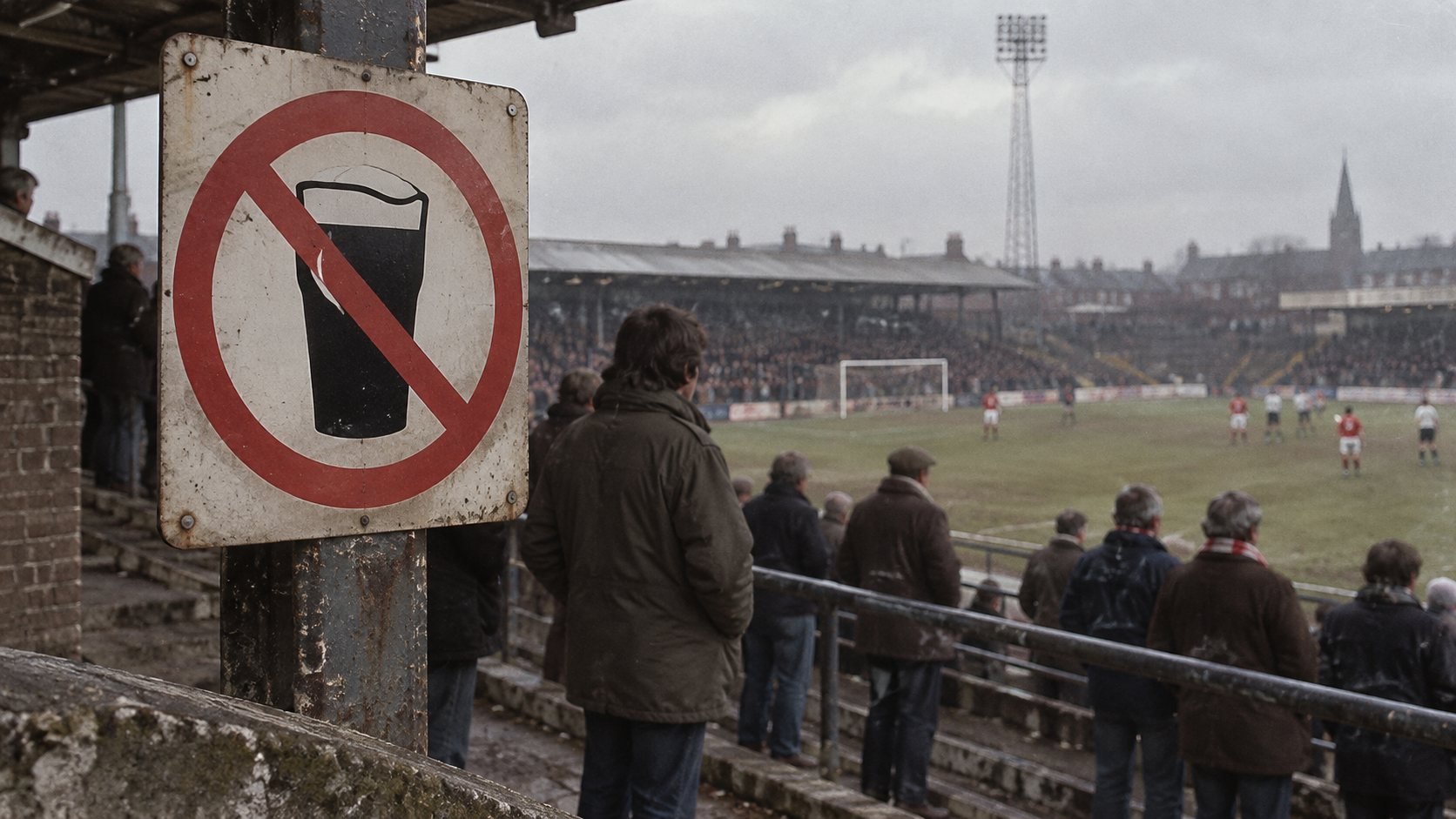
UK prime minister Andy Burnham has criticised what he described as the unfair treatment of football supporters who are prohibited from drinking alcohol while watching matches from the stands, suggesting that the legislation could be revised.
Margaret Thatcher’s government introduced the restriction quickly in 1985 as part of an effort to tackle football-related violence, which had affected the club and international game for decades. Officials regarded heavy alcohol consumption as an important contributor to public disorder.
The disorder at the notorious FA Cup fixture between Luton Town and Millwall in March 1985, together with the Heysel Stadium tragedy, accelerated political and legal demands for stronger measures. One result was the Sporting Events (Control of Alcohol etc.) Act 1985, which prohibited alcohol at football grounds in England and Wales. A similar ban had applied at Scottish football venues since 1981.
Following lobbying from clubs, the legislation was revised through the Public Order Act 1986, relaxing the restrictions governing alcohol service in executive boxes and boardrooms.
Supporters attending men’s football matches in England and Wales may currently drink alcohol only in stadium areas from which the pitch cannot be directly seen.
Prime minister plans talks with FA officials over football violence
By Colin Brown and Robert Armstrong
15 March 1985
The prime minister invited Football Association representatives to attend a meeting about measures for combating violence and disorder at football grounds.
Stricter court sentences, restrictions on alcohol inside stadiums and sanctions against clubs linked to misconduct were expected to feature prominently after the rioting that followed Wednesday evening’s FA Cup match between Luton and Millwall.
Home secretary Leon Brittan, who faced opposition criticism over the policing of the match, requested a report from Bedfordshire chief constable Andrew Sloan by the following morning. Sports minister Neil Macfarlane also told the House of Commons that he had given the FA one week to submit its findings.
The minister said he wanted details of the steps the FA planned to take against clubs whose supporters had an established record of violence. He added that the prime minister would meet FA officials once the report had been completed.
Macfarlane believed that violence among football supporters was mainly concentrated in London. Speaking at the Department of the Environment, he suggested that the large number of league clubs in south-east England generated intense rivalries that could sometimes erupt into physical conflict.
His comments came after an information-gathering meeting at the department with Luton manager David Pleat and Millwall chief executive Tony Shaw. Macfarlane said he had received a detailed account of the events preceding the riot in the Kenilworth Road stand after Luton won the sixth-round tie 1-0.
The minister voiced concern about possible disorder at the forthcoming matches between Brentford and Millwall at Griffin Park and between Watford and Chelsea at Vicarage Road. He said police would have to remain especially alert and also expressed unease about Sunderland supporters travelling to the city for the Milk Cup final on 24 March.
Macfarlane refused to assess the conduct of the 200 police officers who confronted Millwall supporters accused of damaging a stand at Luton and property elsewhere in the town. He maintained that it would be inappropriate to reach conclusions before receiving the Bedfordshire chief constable’s report and the results of the FA investigation.
A total of 41 people were injured on Wednesday night, including 31 police officers, while damage to the stadium was estimated at £15,000. Shops, houses and vehicles were also damaged, and a special football train was vandalised during its return journey to London.
Thatcher’s intervention was intended to demonstrate the seriousness with which the government regarded football violence. Labour leader Neil Kinnock nevertheless accused her in the Commons of addressing its visible effects rather than its underlying causes.
Although Kinnock did not directly blame Wednesday’s events on unemployment and social deprivation, he argued that both contributed to the broader problem.
He said there was no straightforward solution and called for action addressing the roots of the crisis, rather than relying solely on punishment or warnings to confront widespread offences involving violence, property damage and drug use.
Thatcher rejected Kinnock’s interpretation and kept her response focused on football disorder. She suggested that inadequate discipline from parents and teachers might be involved and argued that additional police personnel and equipment could help control the problem.
She strongly emphasised the deterrent effect of sentencing. Government sources indicated, however, that although a Criminal Justice Bill might appear in the Queen’s speech for the next parliamentary session, magistrates already possessed sufficient powers to punish football hooliganism, ranging from detention-centre orders to lengthy prison terms.
Macfarlane faced calls from MPs to follow Scotland by prohibiting alcohol at football grounds. While possible legislation was being considered, he encouraged clubs to introduce voluntary restrictions themselves.
MPs from across Parliament denounced the unrest. John Carlisle, the Conservative MP for Luton North who attended the match, said local residents were furious about the damage inflicted on their homes, businesses, town and football club and wanted severe consequences for those responsible.
Carlisle went further, arguing that the perpetrators should experience consequences comparable to the physical suffering they had caused others.
Shadow sports minister Denis Howell noted that the government had deployed the country’s police resources during the miners’ strike and demanded an equally forceful response to violent football crowds, which he described as a national disgrace.
Macfarlane maintained that clubs needed to confront a new type of spectator who attended matches primarily in search of violence.
Luton Town’s directors decided that the club would not play Millwall again for the foreseeable future, nor face other teams likely to bring violent supporters. Chief executive John Smith said the club would not expose Luton residents or its own fans to similar incidents, even if refusing to play meant surrendering league points.
Smith acknowledged that stronger preventive action could have been taken. He said groups of supporters had arrived on coaches while intoxicated and confirmed that the names of the coach operators had been passed to police for further action.
Club officials disclosed that Luton had received abusive telephone calls before the match, including numerous threats of physical harm. Ticket-office employees became so frightened that they left early and missed one of the team’s most significant fixtures.
Office manager John Gornell described an aggressive crowd pressed against the glass, with some individuals appearing severely agitated.
Luton later released attendance figures showing that only 5,185 supporters had paid for admission to the visitors’ section, even though the area, with a stated capacity of 8,700, was full.
What do you feel about this post?

Like

Love

Happy

Haha

Sad