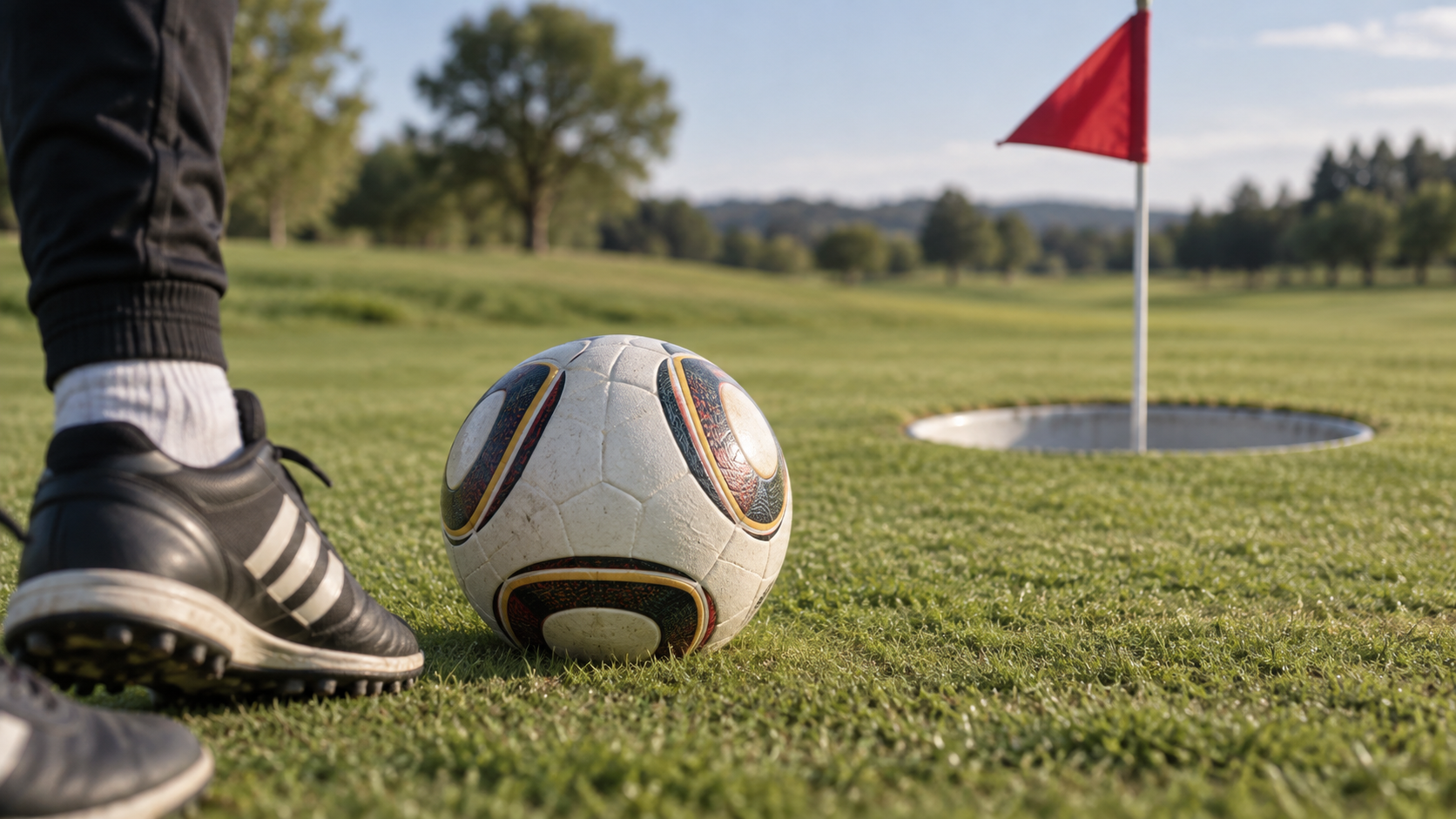
Roughly once each month, Ben Clarke, one of footgolf’s most accomplished players, methodically reinflates his prized collection of Adidas Jabulani balls.
Like many competitors at the highest level, Clarke owns numerous footballs that must be regularly topped up with air to keep them in good condition. That includes untouched examples still stored in their original packaging. Balls are highly valuable in footgolf, a sport in which players kick a ball around a course and aim to complete 18 enlarged holes using the fewest possible shots. Accuracy is crucial.
It may therefore seem surprising that the most treasured ball in Clarke’s collection is the notorious Jabulani. Fabio Capello once labelled it the worst ball he had encountered, and several prominent players shared his criticism. David James found it terrible, Júlio César compared it to a cheap supermarket ball, and Robinho questioned whether its creator had ever played the game.
The ball developed for the 2010 World Cup became infamous because its erratic movement made it extremely difficult to control. Sixteen years later, however, its qualities are perfectly suited to elite footgolf. As a result, owners now possess a valuable collector’s item, with boxed versions selling for more than £500 and prices continuing to climb.
Clarke, who lives in Hertfordshire and has reached the top of the global footgolf rankings five times, finds the situation remarkable. Players struggled to manage the ball during the 2010 tournament, yet footgolfers now depend on it in a discipline built around precision. Despite that contradiction, competitors have complete confidence in it.
The explanation can be found in the same design characteristic that caused so many problems for conventional footballers. Made from eight thermally bonded panels rather than the 14 used in the 2006 Teamgeist, the Jabulani had very few seams and became one of the smoothest and most spherical balls ever produced.
When powerful footballers struck it with little spin, the ball could develop a knuckleball effect and suddenly change direction or drop. Footgolfers, by contrast, usually kick with the inside of the foot to create reliable spin. For them, the minimal seams allow the Jabulani to travel farther than almost any alternative. Similar Adidas models from that period, such as the Teamgeist, Terrapass, Speedcell and first Torfabrik, are among the few that offer comparable performance.
None of those models has been manufactured for nearly 15 years. Strong demand from leading footgolf players, combined with an increasingly limited supply, has caused their prices to rise sharply.
Clarke owns three unopened Jabulanis as well as several other Adidas balls from the same period. He says they are becoming both scarcer and more costly, which has stopped him from purchasing another one in recent years. Most are now obtained from fellow players or collectors who understand how much demand exists within footgolf.
He paid approximately £250 for his most recent Jabulani about three years ago. Comparable balls now cost at least £500, making any collision with a tree that causes one to burst a particularly expensive error.
Many people involved in footgolf agree that relying on these aging balls cannot continue indefinitely. Sean Rontree, a director of the organization responsible for the sport in England, personally owns three Jabulanis and three Speedcells, but believes the available supply will soon run out.
Rontree expects a point when no examples remain for sale. Discussions about restarting production have not succeeded because manufacturing would only be financially worthwhile with an order of roughly 10,000 balls, a quantity the sport cannot currently support.
The shortage has encouraged manufacturers to compete for a replacement. With 1,200 competitors taking part in the recent Footgolf World Cup in Mexico, several businesses are developing purpose-built balls capable of challenging the Jabulani. FGB from Malaysia, Squb from the Netherlands, Triero from Britain and Birdie from Brazil have introduced specialist footgolf balls priced at around £100.
FGB founder Jeffrey Cottam believes his company’s third-generation model offers better overall build quality and requires fewer repairs. Even so, he acknowledges that neither his business nor its rivals have yet produced a ball that can fully outperform the Jabulani.
The main obstacle is achieving the same distance. Cottam estimates that his ball finishes around five to seven metres behind the Jabulani. He also hopes to reproduce its exceptional bounce, which allows it to keep moving along the fairway. His goal is to release a new model next year that matches or surpasses the older ball in every area, something he regards as an inevitable step in the sport’s development.
Clarke takes a practical view of the issue. He understands that footgolf cannot depend forever on a small and gradually deteriorating supply. Until a genuine successor becomes available, however, he intends to continue his monthly routine of maintaining the Jabulanis he still owns.
He finds it extraordinary that players must take such careful measures simply to ensure a ball remains usable when required. One of his recently developed a leak through a panel, perhaps because it had not been inflated often enough. For Clarke, the entire footgolf ball market has become increasingly absurd.
What do you feel about this post?

Like

Love

Happy

Haha

Sad