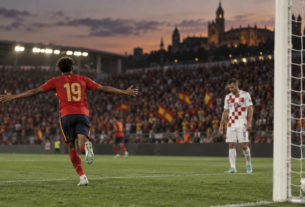
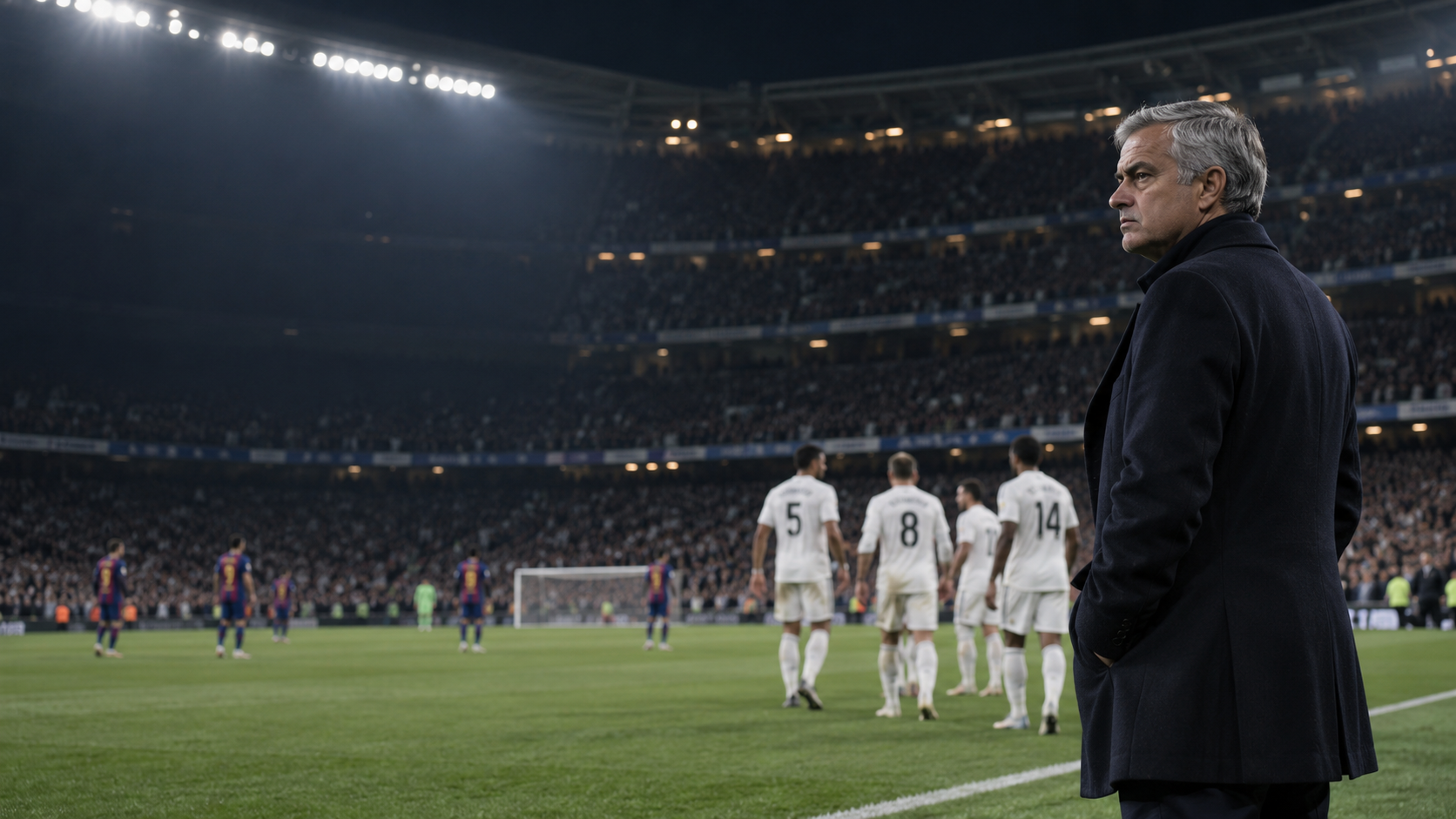
José Mourinho had already revived the por qué?, produced the printout and skipped a press conference, all within his first 100 days. Now he could add a knee-slide celebration, performed in the ideal setting: the place where his story began and where a new chapter might start. Mourinho barely reacted when Kylian Mbappé opened the scoring in Sunday night’s clásico, remaining seated in the darkness of the dugout. But when the forward struck a late winner, the response was completely different. The 63-year-old charged into the light, dropped to his knees on the grass, muddied his trousers, stuck out his tongue and punched the air.
Few things delight him more than seeing a strategy succeed. The substitutes rushed from the bench to join their teammates near the south-west corner, where the players celebrated while avoiding bottles thrown from the stands. Far above them, enclosed behind glass, the small contingent of travelling Madrid supporters erupted with joy. Hundreds of phones appeared in the main stand. Meanwhile, 600 kilometres away in Boadilla, Thibaut Courtois watched from his sofa, likely wrapped in a blanket with cold medicine nearby. He had awakened with flu on the morning of the season’s biggest match and was unable to take part.
“We have the finest goalkeeper in the world, but nobody cried because Thibaut was unavailable,” Mourinho said. His absence certainly gave Madrid another reason to worry. Yet the coach turned to Andriy Lunin, a reserve so dedicated that he bought artificial turf and practised diving around his apartment during the pandemic. Mourinho told him that this was the opportunity he had prepared for: “You train so you can play, not remain on the bench. Now go and do it.” The message to everyone else was equally simple: nothing had changed and the original plan still stood. By the time the squad returned to the dressing room, triumphant shouts echoed through the Camp Nou corridors, proving that confidence justified.
Thirteen years after his previous spell, Mourinho returned to Barcelona for another clásico and led Madrid to a 2-1 victory. Few expected the contest to unfold this way, although perhaps its unpredictability made perfect sense. Barcelona entered after nine straight wins and were averaging 4.3 goals per game. Madrid, by contrast, had already lost twice and had often looked unconvincing. A night that might have effectively ended the title race before November instead brought it fully to life. “Leaving here nine points behind would be a serious psychological burden,” Mourinho said. “Six points would feel more manageable, but three changes everything.”
This result changed the mood of the entire season. Including the encounters from his earlier tenure, Mourinho has now gone six consecutive matches against Barcelona without losing. Madrid achieved it without simply placing everyone behind the ball or relying on excessive physicality. They did not merely cling on in desperation, although Dean Huijsen did block one attempt with his face. Nor did they spend the entire game waiting to steal a single opportunity, despite João Cancelo’s observation: “That is Madrid. They may not create many openings, but they convert them.” Barcelona finished with an 18-10 advantage in shots and held 62% of possession.
“How we won matters,” Mourinho said. “A team can prevail through luck or by defending continuously, but we remained composed and fully deserved the result. We stayed organised and alert, and we had the bravery to play out from defence.” That assessment may have been slightly generous. The discussion could have sounded very different had Lunin not produced a remarkable stop against Gerard Martín, or had Lamine Yamal’s second-half effort not drifted narrowly wide. Even so, the manager’s argument carried weight.
Barcelona were below their usual standard. Their play was rushed and inaccurate, prompting Rodri to urge his teammates to calm their “pulse rate” as they returned for the second half. Lamine Yamal also wasted an exceptional opportunity shortly before the interval. Barcelona increased the pressure after the break but could not find a route through Madrid’s defensive barrier. Xavi Espart then left the field injured, adding to the problems at the back and renewing scrutiny of the club’s failure to recruit another central defender. Nevertheless, Madrid were quicker, more compact and more aggressive than anticipated. When asked to explain the performance, Lunin chose two words: “discipline and attitude”. Those qualities should be expected on such an occasion, but Madrid have not always displayed them.
There was more to the performance than determination, or Marc Cucurella’s successful attempts to unsettle Lamine Yamal. Madrid repeatedly targeted the space behind Barcelona’s full-backs. Yan Diomandé, only 19 and excellent in his first clásico, recorded more touches than any other Madrid player while also providing protection for his own full-back. The winning goal offered another layer, combining imagination and precision. Jude Bellingham danced through the move, shifting the ball between his feet and through Gabriel Jesus’s legs before turning to release Eduardo Camavinga. It was the work of a team with a clear concept, and the victory provided powerful support for its manager’s methods.
Before kickoff, Rodri suggested that one of Madrid’s strengths was persuading opponents to underestimate them, although he insisted he would avoid that mistake. Even so, Madrid’s approach had a significant impact on him and Pedri. Bellingham restricted Rodri, while Bernardo Silva did the same to Pedri. Under pressure and showing signs of fatigue, as Hansi Flick later noted, neither midfielder managed to control the game. Selecting Arda Güler alongside Silva, who was making his first league start in six weeks, demonstrated Madrid’s desire to retain possession whenever possible. For once, they had a functioning midfield. They attempted to build patiently from the back and draw Barcelona forward. When the match demanded deeper defending, however, they were equally willing to place bodies between the ball and goal. Barcelona had six attempts blocked and saw at least two others taken away at the last moment. Madrid, meanwhile, attacked with greater purpose and created arguably the clearer opportunities, reflected by an expected-goals comparison of 1.19 to 1.94.
The victory moved Madrid to within three points of Barcelona and, according to Federico Valverde, could “give us the push we need”. Ten weeks into the campaign, the contest is alive again. Hay liga, as the familiar Spanish phrase goes: there is still a title race, and Madrid are firmly involved. The first signs of change appeared in Rome, where 70 poor minutes were followed by 20 encouraging ones. That comeback, unlike some of the club’s more mysterious recoveries, had a recognisable explanation. Mourinho made substantial alterations: Valverde and Aurélien Tchouaméni were separated in midfield, with Valverde moving to right-back; Güler and Diomandé entered the side; and Vinícius Júnior was left out. “I am not inflexible. I can make changes,” Mourinho said. Madrid have since collected five consecutive victories, discovering a possible route forward that night. Although it may be simplistic and even harsh to highlight, they have won every match since Vinícius was suspended. The sequence also happens to coincide with Mourinho growing a beard, for anyone inclined to believe in such omens.
Before the clásico, Mourinho argued that comparing his developing team with Barcelona was unreasonable. Madrid remained far from the finished article, he said, and he was still learning about players he had coached only briefly. After the match, however, he acknowledged the progress: “We have improved, and there is no point pretending otherwise.” His thinking about midfield now appears transformed. “I have discovered something about that area of the pitch,” he explained. “A blend works better. It is preferable to combine different qualities rather than use two players with similar attributes.” Put plainly, pairing Tchouaméni with Valverde had not produced the desired balance. Madrid needed more creativity in midfield, and that realisation initiated the tactical adjustment. Sunday’s performance served as confirmation that an identity and a renewed sense of possibility are beginning to emerge.
The reaction in the Spanish press suggested that Madrid had rediscovered themselves at the Camp Nou and had re-entered the title race. Mourinho, however, immediately tried to control expectations. “I will not allow their heads to drift into the clouds,” he said. “If we win here and then fail to win at the Sardinero, this result will mean very little.” Even so, the victory represented more than an isolated achievement; it felt like the beginning of something. At full time, Mourinho walked on to the pitch and shook Lunin’s hand while players embraced around them. The travelling supporters remained high in the north-east corner, singing long after the whistle. Courtois continued watching from home. He had endured what the club described as a terrible Saturday night, but by then he was beginning to recover. The same could be said for everyone connected with Madrid.
What do you feel about this post?

Like

Love

Happy

Haha

Sad