It was an awards ceremony that, as Michael Owen acknowledged, could have been handled with a simple phone call, just as it was when he won in 2001. Twenty-five years later, footballers, influential officials, an acrobatic dancer and several noisy hecklers gathered in a ballroom for a demanding three-hour event. Beyond showing viewers how valuable their spare time is, what did the men’s Ballon d’Or ceremony reveal?
Individual brilliance is difficult to separate from team success
As has often been the case in recent years, the voting panel appeared to place considerable importance on collective achievements alongside individual performances.
That does not mean Harry Kane lacked a compelling personal argument. Widely considered the favorite, he was also named the year’s leading men’s striker around 45 minutes before receiving the main award. His record of 64 goals in 56 club appearances was extraordinary, while his growing ability to create opportunities with precisely weighted through balls further strengthened his reputation.
Kane has become an exceptional producer of goals and assists during an era dominated by carefully organized tactical systems. Other celebrated players operating within similarly structured teams found it harder to distinguish themselves. Arsenal won the Premier League and reached the Champions League final, but Declan Rice was their highest-ranked player in 15th place. Paris Saint-Germain received the club of the year award, although their best-placed player, Khvicha Kvaratskhelia, finished sixth.
A disappointing club season can also weaken the case of even the biggest stars. Rodri, who placed fourth, and eighth-ranked Erling Haaland impressed at the summer World Cup, but Manchester City’s failure to finish above Arsenal appeared to damage their chances. Real Madrid’s turbulent campaign similarly affected several credible contenders. One of the biggest surprises before the ceremony was the announcement that Jude Bellingham had finished 11th, suggesting that his club performances had outweighed his outstanding World Cup displays.
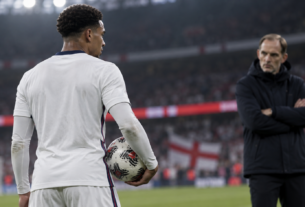
Ultimately, the contest centered on two outstanding forwards whose individual quality rose above the achievements of their famous clubs. Kylian Mbappé ended the season with Spain’s second-best side and helped his country finish fourth at the World Cup. Kane’s England defeated France in an extraordinary third-place match, while his leading role for Bundesliga champions and Champions League semi-finalists Bayern Munich may have supplied the decisive advantage.
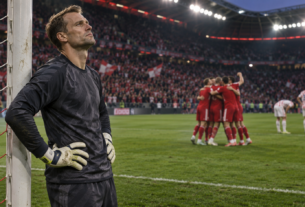
Mbappé was therefore left watching in visible disappointment as one of his major rivals collected the award he has pursued for years.
A major lift for Bayern and the Bundesliga
Germany’s attack-focused style has often worked against Ballon d’Or candidates representing Bayern Munich and other Bundesliga clubs, largely because goals scored in Europe’s most prolific major league are sometimes valued less highly. Kane’s victory ended a 30-year wait for the competition, whose previous winner was Matthias Sammer in 1996. Robert Lewandowski appeared certain to claim the prize in 2020, but the ceremony was canceled because of the Covid-19 pandemic. As a result, the league’s long-standing disadvantage continued for another six years.
The familiar question was whether voters would apply the so-called “Bundesliga tax,” a phrase more commonly used when assessing transfers from Germany. Would Kane’s scoring record across every competition for Bayern be considered superior to Mbappé’s return of 43 goals in 47 appearances for Madrid?
Bayern appeared to understand the significance of the occasion. Their three other shortlisted representatives, Michael Olise in ninth, Luis Díaz in 24th and Dayot Upamecano in 26th, attended despite knowing they were unlikely to win. In the weeks before the ceremony, both the club and league promoted Kane’s credentials extensively and repeatedly asked what receiving the honor would mean to him. His response made clear that it mattered greatly.
The result also carries substantial importance for Bayern and German football. Since 1996, based on the club that employed each winner for most of the relevant year, La Liga produced 17 recipients, including seven other than Lionel Messi or Cristiano Ronaldo. Serie A supplied five, the Premier League three and Ligue 1 two. Messi formally received his eighth and final award while representing Inter Miami, although it recognized his displays for Paris Saint-Germain and Argentina. Technically, that meant a player from Major League Soccer had won more recently than anyone from the Bundesliga.
Vincent Kompany’s Bayern are beginning to alter those opinions, with their exciting journey to last season’s Champions League semi-final demonstrating the level the club can reach at its best.
The World Cup now has a different influence
Kane’s success continues the pattern of the award going to players who are not reigning World Cup champions. Since Fabio Cannavaro won in 2006, Messi in 2023 is the only recipient to have taken the honor during a voting cycle connected to a world title. Argentina lifted the 2022 World Cup in Qatar in December, after that year’s individual prize had already been presented.
This represents a reasonable departure from the voting habits of the 20th century. A tournament lasting only a few weeks can define a player’s legacy, but it should not automatically outweigh the previous 11 months of performances for club and country.
Spain were dominant on their way to a second World Cup triumph. Luis de la Fuente was a deserving choice as coach of the year, while Unai Simón’s commanding goalkeeping earned him the corresponding individual honor. Even so, third-placed Lamine Yamal and Rodri finished behind the leading contenders. Yamal might have become the youngest winner in history had he entered the tournament fully fit. Voters may also be waiting for his game to mature further before supporting him, much as Mbappé was repeatedly overlooked during his years in Paris.
Even so, the right blend of player, national team and World Cup journey can influence the most skeptical voter. Argentina’s dramatic progress to the final created precisely that kind of story. Supporters and analysts still remember Messi’s ability to produce moments of brilliance under the greatest pressure. Had Argentina successfully defended their title rather than delivering a poor performance against Spain, sentimental voters might have been tempted to place Messi first one final time.
Instead, Messi finished fifth. Considering the lower standing of Major League Soccer within the worldwide hierarchy, that remains an impressive result, even before taking his previous achievements into account.
What do you feel about this post?

Like

Love

Happy

Haha

Sad