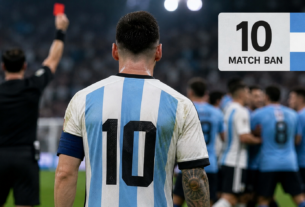
Fifa has retaliated against Uefa in their escalating dispute over the cancellation of USA forward Folarin Balogun’s suspension, accusing the European body of hypocrisy for condemning the ruling.
In a statement credited to Mohammad al-Kamali, head of Fifa’s disciplinary panel, released before the USA’s last-16 defeat by Belgium, Fifa maintained that “reversing red cards is a routine disciplinary practice” in leagues under Uefa’s umbrella, “and it has never sparked fears of breaching any ‘red line’.”
The Fifa statement stood by the contentious choice to lift Balogun’s ban, describing it as “an even-handed step” and “not an innovation in contemporary football.”
On Monday, Uefa charged Fifa in a sharply toned release with overstepping “a red line” that eroded the credibility of the World Cup by allowing Balogun to feature against Belgium even though tournament regulations mandate an automatic one-match ban for red cards.
The last-minute reprieve for Balogun following his dismissal in the USA’s last-32 victory against Bosnia and Herzegovina is unprecedented in a World Cup, following persistent pressure on Fifa from Donald Trump and other high-ranking White House figures.
“Examining the legal aftermath of red cards in football is not a recent development,” Fifa commented. “In most elite domestic leagues run by Uefa’s member federations, reversing red card decisions occurs regularly as a disciplinary tool, and it has never provoked worries about crossing any ‘red line’.”
“It must be stressed once more that in the decision being questioned, the red card was not cancelled. Putting the consequences of a red card on hold based on a clear rule in the relevant statutes constitutes a far more proportional step.”
Al-Kamali’s statement made no mention of Trump’s involvement, but insisted the disciplinary body operated autonomously from the executive branch, led by President Gianni Infantino.
Fifa remained quiet about the matter from the time it declared Balogun eligible to play Belgium until Trump revealed his participation, telling an Oval Office media briefing that he phoned Infantino to request a review of the red card.
Donald Trump has stated he telephoned Gianni Infantino to request a review of the red card. Photograph: Jacquelyn Martin/AP
Infantino later released a statement stressing he had no part in the ruling before Fifa put out al-Kamali’s remarks seeking to explain the procedure.
“The Fifa disciplinary panel, like all other Fifa judicial organs, operates independently in line with the Fifa statutes and disciplinary code,” the communiqué read. “The chairs, vice-chairs and other members of these bodies meet the autonomy requirements set out in Fifa’s governance rules to guarantee their neutrality.
“Second, the Fifa disciplinary body did not overturn the referee’s match decision to dismiss Mr. Balogun; instead, it affirmed a one-match suspension for Mr. Balogun stemming from the red card issued on 1 July 2026.
“Article 66.4 of the Fifa disciplinary code stipulates that ‘a dismissal results in an automatic ban for the next match’. Likewise, Article 10.5 of the regulations for the 2026 Fifa World Cup states that ‘a player or team official receiving a red card, whether straight or via two cautions, is automatically banned from the team’s next fixture, and additional penalties may be applied’.
“In accordance with Article 27 of the FDC, the Fifa disciplinary panel chose to defer, on a one-year probationary basis, the enforcement of the automatic match ban imposed under Article 66.4 of the Fifa disciplinary code and Article 10.5 of the World Cup 26 rules. This stay was granted after reviewing all the particular circumstances of the incident and the evidence at hand.
“Pursuant to Article 27 of the FDC, the Fifa disciplinary body may exercise its authority to pause the effect of any sanctions, excluding those for match-fixing – a scenario not applicable here. It is worth noting that applying Article 27 is not without precedent; comparable rulings were made during the 2026 World Cup qualifying phase.
“Neither the Fifa disciplinary code nor the 2026 World Cup regulations contain any clause forbidding the disciplinary committee from using its discretion under Article 27. Using that discretion aligns with the foundational principles for determining sanctions set out in Article 25 of the Fifa disciplinary code.”
Infantino had previously asserted that he learned of the disciplinary committee’s ruling only after its release. “I review the decisions of the Fifa disciplinary code once they are announced,” he stated. “Occasionally I am taken aback by them. At times I concur, and at other times I do not.”
Belgium continues to express fury over Fifa’s ruling and is weighing a challenge at the Court of Arbitration for Sport.
What do you feel about this post?

Like

Love

Happy

Haha

Sad