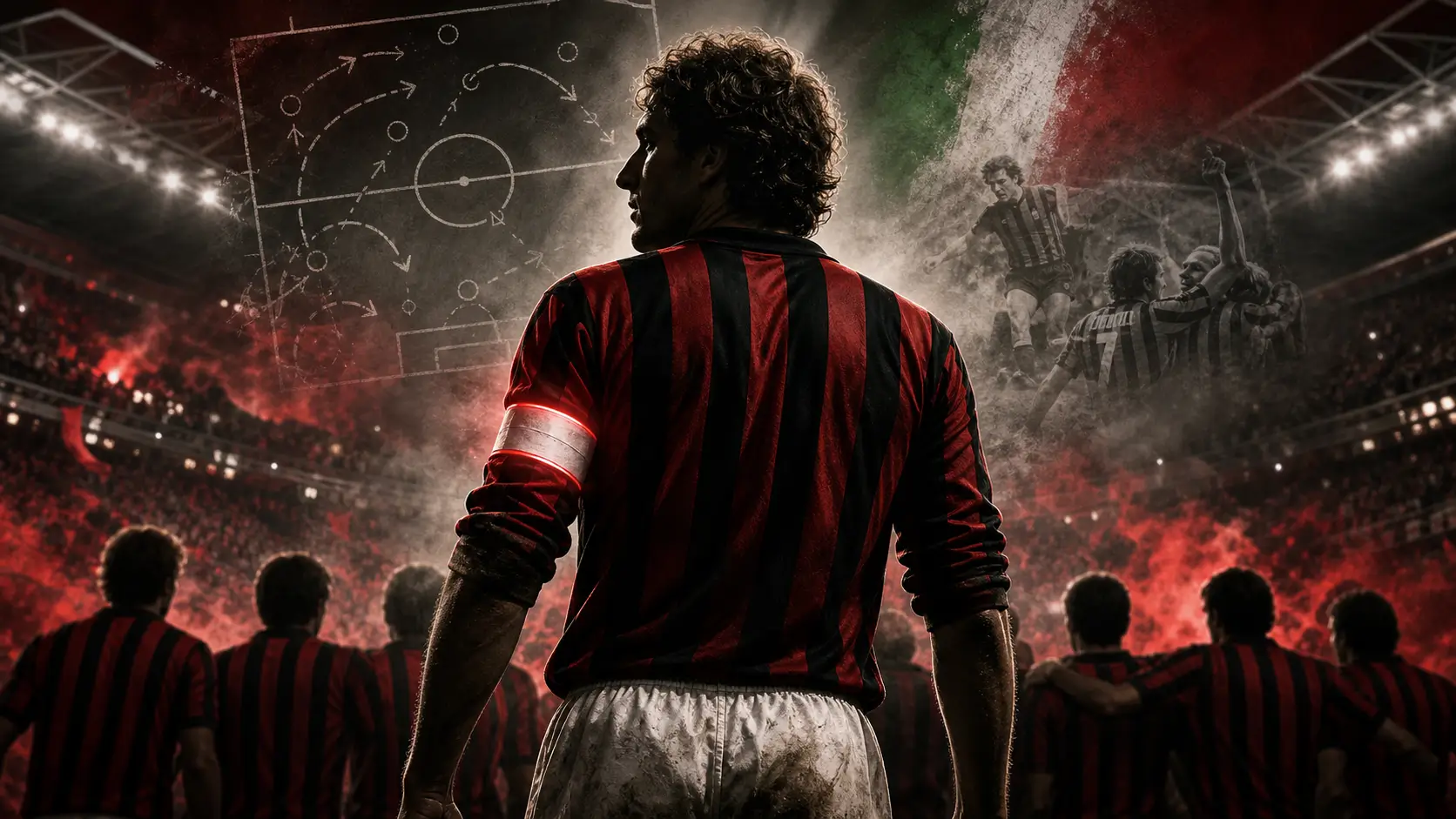
Only a handful of footballers become synonymous with the role they play and earn admiration across the game. For those who followed football during the late 1980s and early 1990s, Franco Baresi represented the ideal central defender. Widely regarded as the finest in the world, he embodied defensive excellence despite being unlike most conventional players in that position.
Baresi had only recently celebrated his 19th birthday when he claimed his first scudetto with Milan under Nils Liedholm in 1979. Italian football was still shaped by the principles of catenaccio, with defensive units commonly featuring a libero, two dedicated markers and, occasionally, an adventurous left-back. Liedholm chose a different approach. The Swedish coach introduced zonal marking to Serie A and viewed football as a contest for space rather than a collection of individual physical duels. Although Baresi was a 5ft 9in teenager whom more conservative coaches might have overlooked, Liedholm recognised his exceptional ability to understand the game. He played throughout the campaign, featuring regularly in the league, Coppa Italia and Uefa Cup.
The following period brought severe turmoil to the club. After the season’s final match, players were detained on the pitch amid the Totonero gambling investigation, which eventually resulted in Milan being demoted. Financial instability followed, and an immediate return to the top flight was succeeded by another relegation. Although Milan earned promotion once more, the outlook remained uncertain until Silvio Berlusconi assumed control in 1986. Baresi stayed committed through every setback. Having lost both parents before turning 16, he came to regard Milan as a second family.
He spent his entire playing career with the club, recording 719 appearances across all competitions during two decades. Yet his path could easily have taken him to Inter. His older brother Giuseppe was already there when 14-year-old Franco attended a trial. Inter questioned whether he had the necessary physical stature and invited him to return a year later. Instead, he tried out for Milan—the team he maintained he had always supported—and earned a place.
Berlusconi arrived as an outsider eager to challenge established conventions. He found a similarly bold figure in Arrigo Sacchi, appointed in 1987. Sacchi expanded upon Liedholm’s early use of zonal defending, introducing a flat back four combined with intense pressing. Such methods appeared radically unconventional in Serie A at the time. Traditionalists doubted the project, particularly after Milan lost their second league match 2-0 at home against Fiorentina, suffered a Uefa Cup defeat by Espanyol and then drew disappointingly with Cesena. Critics joked that the new coach would be gone before All Saints’ Day on 1 November.
Results gradually improved, but Sacchi became concerned that his demanding methods had exhausted the squad and reduced the intensity of training. Baresi then made a crucial contribution by urging him to work the players even harder. He believed they needed constant repetition to fully absorb the new system. Instead of relying on fixed instructions, each player had to judge his position through the changing relationship between opponents, teammates, the ball and available space. Only sustained practice could turn those decisions into instinct.
The captain’s support proved enormously important to Sacchi. Baresi was both the team’s leader and its ethical centre, so his acceptance of the new philosophy encouraged the rest of the squad to embrace it. Milan captured the scudetto in 1988 before winning two successive European Cups with a style that produced some of the era’s most unforgettable football. Baresi was fundamental to that success. He neutralised attackers, directed the defensive line, read developing situations and launched counterattacks. His precise forward pass became one of his signatures, while his outstanding judgment ensured that he rarely surrendered possession.
Baresi drew inspiration from technically gifted footballers as well as Ruud Krol, but elegance did not prevent him from being fiercely competitive. Gianfranco Zola described him as the finest defender he faced, while noting that playing against him left opponents needing ice and anti-inflammatory treatment. Like many Serie A defenders of that period, Baresi could deliver forceful challenges, yet he was equally capable of enduring pain. During a Milan derby in 1989, he played for more than an hour with a fractured arm and helped his side preserve a clean sheet. At the 1994 World Cup, he underwent knee surgery after damaging cartilage in the second group match but recovered in time for the final. He again guided the defence to a clean sheet, only to miss his penalty in the shootout as Italy were beaten by Brazil.
Baresi’s international career did not provide the same rewards as his achievements at club level. He belonged to Italy’s World Cup-winning squad in 1982 without making an appearance and later helped the national side reach the semi-finals of Euro 88 and Italia 90. Nevertheless, his time with Italy never delivered glory comparable to what he experienced with Milan.
His lasting image is therefore inseparable from Milan’s red-and-black colours: reading an attack before anyone else, moving decisively ahead of an opponent, winning possession and sending a perfectly measured pass towards a teammate. That combination of intelligence, authority and technical precision came to symbolise a new age of Italian defending.
What do you feel about this post?

Like

Love

Happy

Haha

Sad