In the past few decades, Salé, situated across the river from Rabat on Morocco’s Atlantic shoreline, has changed dramatically. At the beginning of the century, it remained a rugged working-class city whose worn historic quarter was convincing enough to portray Somalia’s capital, Mogadishu, in the film Black Hawk Down. Since then, however, the country’s authoritarian leadership has overseen a transformation of extraordinary scale, much of it unfolding with limited restraint.
Over 40 years, the city’s population has increased threefold. Informal settlements have been removed, frequently through force, to clear space for ambitious developments including a tram network, high-end tourist facilities, a polished marina, the Technopolis business district and, since last July, Fifa’s African headquarters. With its combination of upheaval, ambition, relentless determination and aggressive commerce, the city seems an appropriate place for an embattled leader to mount a final attempt at survival.
Reports in the Times claim that Gianni Infantino has remained secluded in Salé this week while trying to preserve his presidency. His advisers are said to have urgently contacted Fifa Legends, the organisation’s paid former-player representatives, hoping they would publicly defend him. On Wednesday, Luís Figo delivered an unmistakable response. He demanded Infantino’s departure and denounced the proposal to sell private investors a share of the World Cup, describing it as exceptionally dishonest, cowardly and motivated by personal gain.
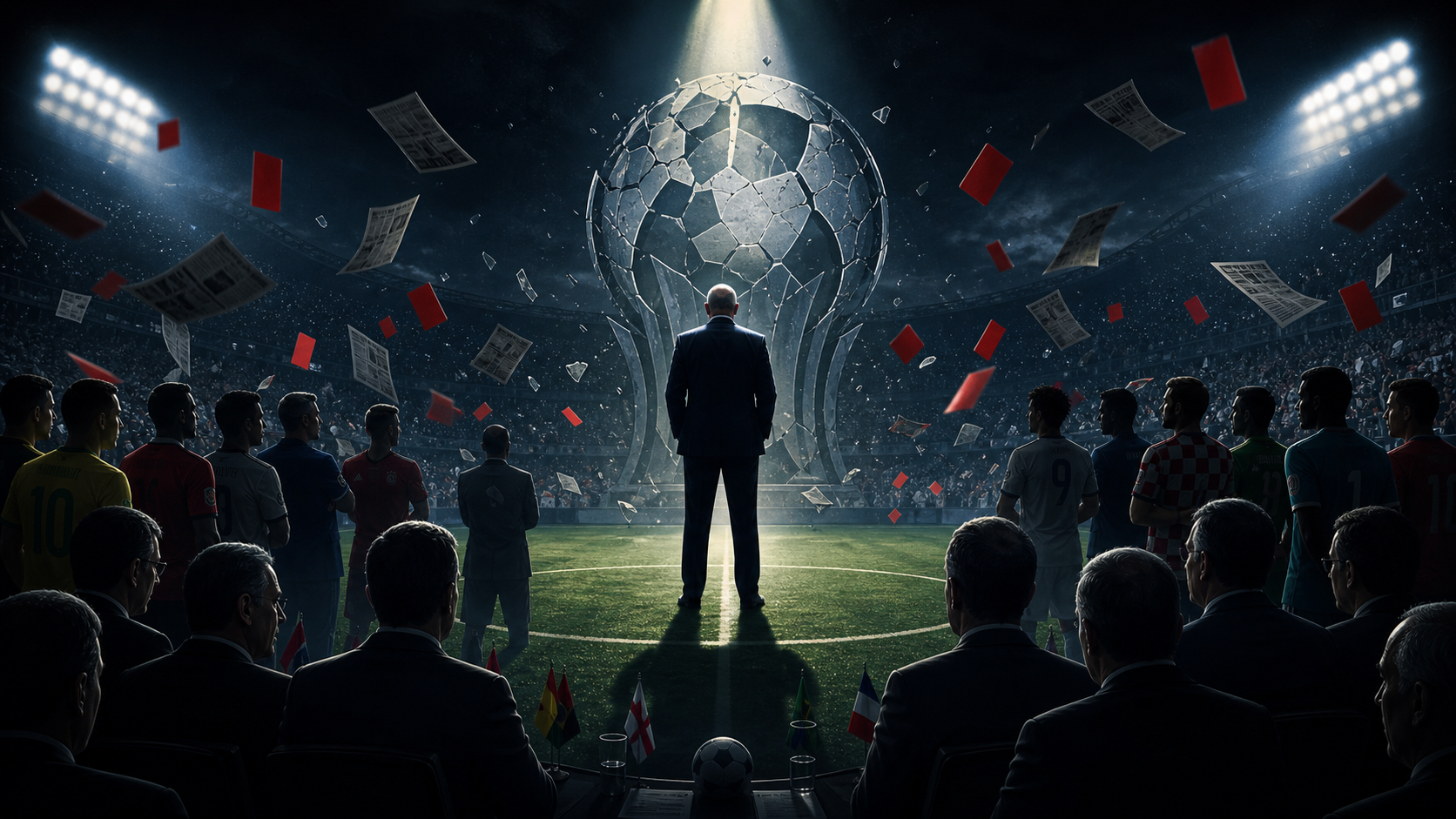
At the same time, senior figures from Uefa, Concacaf and the Asian Football Federation appear ready to challenge him. One proposal is a “governance boycott”, under which representatives would avoid meetings and decline to approve Fifa decisions. The most extreme possibility would be a competing tournament modelled on the World Cup, effectively creating a breakaway movement. Watching Infantino finally face serious resistance may feel satisfying and even deserved. Yet an important question remains: why has the backlash arrived now, and why has it taken this particular form?
Fifa first considered selling part of its commercial inheritance almost eight years ago. In 2018, Infantino provisionally supported an agreement with the Japanese company SoftBank, whose principal financial supporter happened to be Saudi Arabia’s public investment fund. The proposal involved an enlarged Club World Cup and an international Nations League. Although the project eventually collapsed, it produced almost none of the outrage or catastrophic warnings heard during the past two weeks.
Four years have passed since the deeply controversial Qatar World Cup and the “today I feel gay” address that made football’s leading administrator an object of mockery. Two years have elapsed since Saudi Arabia received the 2034 competition through a bidding procedure for which no rival nation seemed properly prepared. Three years have gone by since the Club World Cup was pushed into existence despite widespread concerns about player welfare. Two months ago, Omar Artan was abruptly refused admission to a World Cup where he was expected to officiate. A month ago, Folarin Balogun’s ban was reversed through a process presented as independent.
For the officials who ultimately possessed the power to determine Infantino’s future, none of those events seemed to cross an unacceptable boundary. For years, they approved injustices, humiliations, environmental and reputational harm, broken procedures, manipulated arrangements and the deaths of migrant workers with little meaningful opposition. It is therefore reasonable to ask whether anything fundamental has changed, apart from the sudden chance for ambitious football executives to inherit control of Infantino’s domain.
More than a decade ago, the late Lord Triesman, formerly chair of the FA, compared Fifa to a “mafia family”, and the description remains disturbingly relevant. In many respects, the organisation functions as a body above ordinary law, outside familiar political and economic limits. It follows its own standards and moral framework, maintaining loyalty not through public approval but through a feudal exchange of rewards and protection. Change rarely comes through legislation or revolution, instead arriving through occasional removals resembling the downfall of a criminal boss.
The ethical problems surrounding Infantino’s investment proposal are obvious. Equally remarkable, particularly for a president who has built his reputation on increasing income, is its poor economic logic. There is a single selected purchaser, Joshua Kushner, an apparently invented valuation of $20 billion and an artificial deadline of 19 September. This hardly resembles a serious effort to obtain the highest possible return. It looks more like the conduct of someone seeking a greater share of the wealth he claims to have generated while being legally restricted to one final term in office.
Looking back, Infantino’s eagerness to stretch rules and disregard convention appears to have served as a test of allegiance, demonstrating to billionaire investors that he truly belonged among them. It is therefore unsurprising that, when reportedly trapped, his first reaction was to seek help from Donald Trump, a powerful protector and a figure whose instincts closely resemble his own.
Infantino is commonly portrayed as a symptom while Fifa is identified as the illness. Yet the organisation itself may also be only a symptom. The deeper problem is an authoritarian form of capitalism built on contempt for human life and the assumption that certain people are entitled to command while everyone else must obey. That corruption will remain rooted in many institutions long after Infantino poses for his final celebrity photograph, after “45/47” eats his last Big Mac in the Oval Office and after a replacement leadership enters under the ceremonial banner of reform.
Football, perhaps the most successful shared activity humanity has created, will survive. Its creativity and capacity to absorb change without being destroyed by it are both its strength and its burden. Like the skyline of Salé, the sport bends, expands, evolves, becomes wealthier and eventually looks almost unfamiliar. The ground remains recognisably connected to the place where earlier generations once stood, but the waterfront they knew has disappeared permanently.
What do you feel about this post?

Like

Love

Happy

Haha

Sad