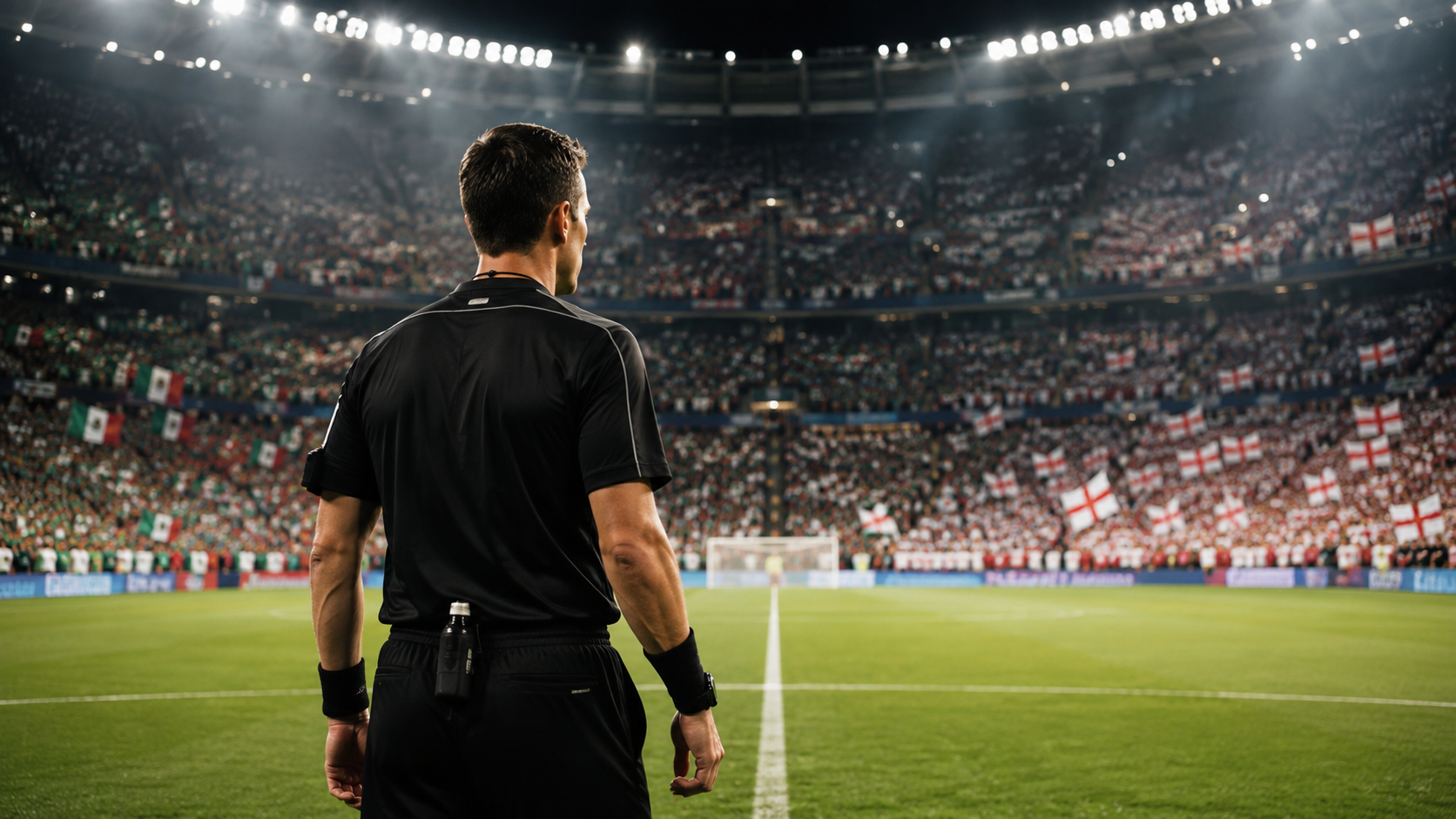
It was 6pm on 5 July in Mexico City, and Alireza Faghani, a 48-year-old Australian-Iranian referee, was sleeping and snoring in the changing room. His assistants had lowered the music. Without the distant sound of almost 90,000 supporters filtering through the concrete walls of the Estadio Azteca, he might have remained asleep until morning.
Faghani had been appointed to officiate the 2026 World Cup last-16 encounter between Mexico and England. Mexico had not been beaten in a competitive match at the Azteca since 2013, partly because they were accustomed to its demanding environment. At an altitude of 2,240 metres, the reduced oxygen levels made it difficult for visiting teams even to breathe comfortably, never mind secure a victory.
This was Faghani’s third assignment at his fourth World Cup. With a chance of being selected for the final, he knew an assured display was essential. Heavy rain was falling outside and thunder rolled above the stadium. The storm had pushed kick-off back by an hour, but the delay did little to quieten the crowd, whose drumming and singing continued.
Eventually, the noise stirred Faghani. He rinsed his face with water and went through his notes once more. Because he refereed in Australia’s A-League and was unfamiliar with many of the players, he had researched what provoked them, how they reacted emotionally and how they behaved in different phases of a match. He explained that preparation involved identifying the influential players and learning their usual responses to particular situations.
Uncertainty over the starting time had disturbed his preparations. Several days earlier, with severe weather forecast, Fifa officials had considered moving the game forward by six hours. The proposal was later abandoned after Keir Starmer, the British prime minister at the time, expressed concern that an earlier start would benefit Mexico by reducing England’s opportunity to acclimatise to the altitude.
While the schedule remained unclear, Faghani had to keep adjusting his exercise and nutrition plans. He found the disruption uncomfortable. Although he did not consider himself superstitious, he valued a familiar routine because it helped him feel settled and step on to the pitch with a clear head.
Even so, he tried not to waste energy worrying about circumstances beyond his influence. He believed that officiating at the highest level required composure and an ability to preserve normal preparations while everything nearby was shifting.
As the match drew closer, Faghani also avoided studying his notes excessively because he did not want prior expectations to distort his judgment. Anticipating that a player would go down easily in a one-on-one duel, for example, could make genuine contact appear to be simulation. Likewise, ordinary movement might be mistaken for a deliberate kick. Entering a game with fixed assumptions, he said, could be hazardous.
Instead, he pictured how the opening exchanges might develop. He attempted to shut out everything beyond the dressing room and direct his attention solely towards the contest. Mexico often began matches aggressively, while England tended to challenge firmly. The officials therefore expected a fast, intense game, especially during transitions and individual battles, and needed to be mentally ready for its pace.
England began the game amid loud jeers that followed virtually every touch. Faghani remembered the extraordinary volume. The noise that had awakened him now risked becoming both a distraction and an influence on close decisions, so he worked to tune it out. He remained conscious of the charged atmosphere and knew that Mexico’s home support would respond forcefully whenever a call affected their side.
At first, he hoped to allow the contest to establish its rhythm without becoming too prominent. His aim was to measure its intensity before deciding how firmly to intervene. In his view, every game develops a distinctive character, and a referee must recognise it quickly and adjust accordingly.
The match gave him no time to do that. Within seconds, Declan Rice reached for a loose ball and struck an opponent’s head with his boot. With almost the entire game remaining, Faghani would have preferred not to issue an early booking. Once a player receives a yellow card, the referee has less freedom to manage later incidents because another caution brings a dismissal and can dramatically change both the balance and entertainment value of the contest.
Nevertheless, Faghani believed he had to act. He needed to show immediately that dangerous tackles would not be accepted, fearing that similar incidents might follow otherwise. He raised the yellow card, prompting an enthusiastic response from the Mexican crowd. To him, the caution was straightforward and established the disciplinary boundary from the outset.
England manager Thomas Tuchel angrily confronted the fourth official from the technical area. Both teams continued making forceful challenges with the crowd encouraging them, and Rice appeared unlikely to complete the match. Faghani quickly recognised that the game would be emotional, rapid and highly intense. His task was to remain composed, act decisively when required and still leave the players enough freedom to play.
Faghani said that achieving this balance depended on understanding the players and sensing the mood of the contest, although the pressure made that difficult. He was continually weighing whether stepping in would improve the game or disrupt it without good reason.
Frustration grew as minor infringements were penalised while some heavier challenges escaped punishment. After being called for pulling down Jude Bellingham, a Mexican defender raised his arms and repeatedly protested that there had been no foul. Faghani ran towards him, stood directly in front of him and sounded his whistle in a deliberate display of control. He felt that dissent had to be addressed immediately in such an atmosphere. Players were free to communicate, but clear limits remained, and assertive body language could sometimes work better than another card.
Faghani used the same approach shortly afterwards when another Mexican player shouted at him over a delayed throw-in. The strategy appeared effective: the protests subsided and Mexico began producing fluent attacking football.
However, two England moves created the first major turning points, with Jude Bellingham scoring twice. Mexico then pulled one back, making it 2-1. Faghani tightened his fists, aware that the pressure would continue to increase. He nevertheless took a fleeting moment to admire the quality of the play. A referee can appreciate such skill briefly, he said, but must immediately think about the restart, the players’ responses, positioning and the next responsibility.
England preserved their lead until the interval. Back in the changing room, Faghani felt reasonably pleased with his first-half display. He believed the officiating team had struck an appropriate balance over when to intervene, and his goal for the second half was to retain the same focus and consistency.
Even Faghani, though, could not have predicted the events that followed.
In the 52nd minute, Mexico left-back Jesús Gallardo raced along the left flank as England right-back Jarell Quansah charged towards him. The ball moved slowly between them while both players approached at full speed. Reaching it first would have sent Gallardo towards goal, with Raúl Jiménez positioned in the penalty area. Watching from the middle of England’s half, Faghani saw Quansah slide in and make contact with both the ball and Gallardo. Gallardo fell in pain and the home crowd erupted, but the referee allowed play to continue because the challenge initially appeared acceptable from his viewpoint. Mexican staff leapt from their seats, gestured angrily for the game to be stopped and became involved in confrontations with members of England’s staff.
When play next stopped, Mexican players surrounded Faghani, who motioned for them to step back. Video assistant Nicolás Gallo Barragán then asked him to delay the restart while the incident was examined. Faghani felt an immediate sense of unease and mentally replayed the tackle, trying to understand what he might have overlooked. Barragán subsequently directed him to review the footage on the pitchside screen.
Whistles echoed around the ground as Faghani ran to the monitor. Mexican players continued shouting and demanding a dismissal, but their voices soon faded into the background. He recalled that reviewing an incident required an extremely narrow focus devoted entirely to reaching the correct outcome.
Three replays from one camera angle were enough to alter his judgment. Positioned behind Quansah during live play, Faghani had not seen the defender’s boot strike Gallardo high on the shin. He had observed the challenge itself but lacked a clear view of the contact point; the replay removed that uncertainty.
When Faghani held up the red card, Mexico’s supporters reacted as though their team had scored. Tuchel reorganised England from the touchline while the referee struggled for breath. The repeated high-speed runs, he said, made the physical strain increasingly noticeable.
At the exact moment he needed respite, another demanding sprint became necessary. Anthony Gordon chased Harry Kane’s flick towards Mexico’s goal. As the goalkeeper rushed off his line, Faghani ran after the attack, determined to get close enough to judge any collision involving Gordon.
Gordon reached the ball first before the goalkeeper swept away his legs. Faghani both saw and heard the impact, which seemed to unfold slowly, and confidently awarded a penalty. He explained that elite-level fitness was intended to put referees in the best viewing position. Once there, however, they had to become mentally still and assess only the evidence before them.
England’s supporters now celebrated loudly as Harry Kane converted the penalty to make it 3-1. Faghani walked back towards the centre circle, attempting to recover his breath and regain his composure. With half an hour left, he expected Mexico to launch a sustained attack.
That pressure soon resulted in another penalty incident. While trying to clear the ball from England’s area, Kane kicked a Mexican player’s leg. Despite strong appeals, Faghani initially allowed the game to continue. From his position, he had not been persuaded that the contact justified a penalty. Although he heard the protests, he knew player reactions could not replace his own judgment.
Shortly afterwards, Barragán again requested a pause so the incident could be checked. For a second time, Faghani felt deeply uneasy as the review continued. He resisted dwelling on what he might have missed because he needed sufficient calm to assess the replay properly. Questioning himself during the delay would achieve nothing; his responsibility was to remain composed and prepare for the next stage.
At first, the monitor did not reveal what Barragán had identified, and Faghani could not see evidence of a clear mistake. He considered keeping his original decision, as he had done during an earlier match in the tournament.
Barragán then slowed the replay and guided him towards the moment Kane struck the Mexican player’s boot. Kane had made contact with the opponent rather than the ball. Gradually the offence became apparent, until it was impossible for Faghani to overlook. He said the discussion clarified precisely which detail required attention, and the strongest camera angle then made the correct decision much easier to determine.
Mexico converted the penalty, reducing England’s advantage to 3-2 with 20 minutes remaining. More major decisions could still arise, so Faghani had to reset immediately and put aside his disappointment at missing two important incidents in real time. He regarded the video assistant as part of the officiating team, whose collective purpose was to produce the correct final call. Neither one mistake nor several could be allowed to influence what happened next.
England survived the remaining pressure and no further goals were scored. Late in normal time, Mexico’s substitutes and staff pointed towards their watches, insisting that every delay be added. When the board displayed 11 additional minutes, Faghani sighed. His body was exhausted, his thinking had become less clear and the thin air left him unable to fill his lungs properly. The pressure was immense because a single mistake could change history and bring his tournament to an end.
That mistake never arrived. In the 102nd minute, Faghani sounded the final whistle. England’s players dropped to their knees, and he felt tempted to do the same, close his eyes and release the accumulated tension. Later, inside the changing room, he drank plenty of water, listened to music and considered the demanding assignment successfully completed.
Elsewhere in the stadium, Tuchel delivered a harsh assessment of the officiating team. He argued that the referees and fourth officials had fallen below the required standard. In particular, he challenged the penalty awarded to Mexico, questioning whether the original decision had involved a sufficiently clear error to justify intervention. In his view, the review had overturned an incident that had not initially been judged a foul.
Faghani chose not to focus on the criticism. Several hours later, after the Azteca had become quiet, he ate a light evening meal and went to bed. He soon entered another deep sleep, this time without disturbance.
What do you feel about this post?

Like

Love

Happy

Haha

Sad