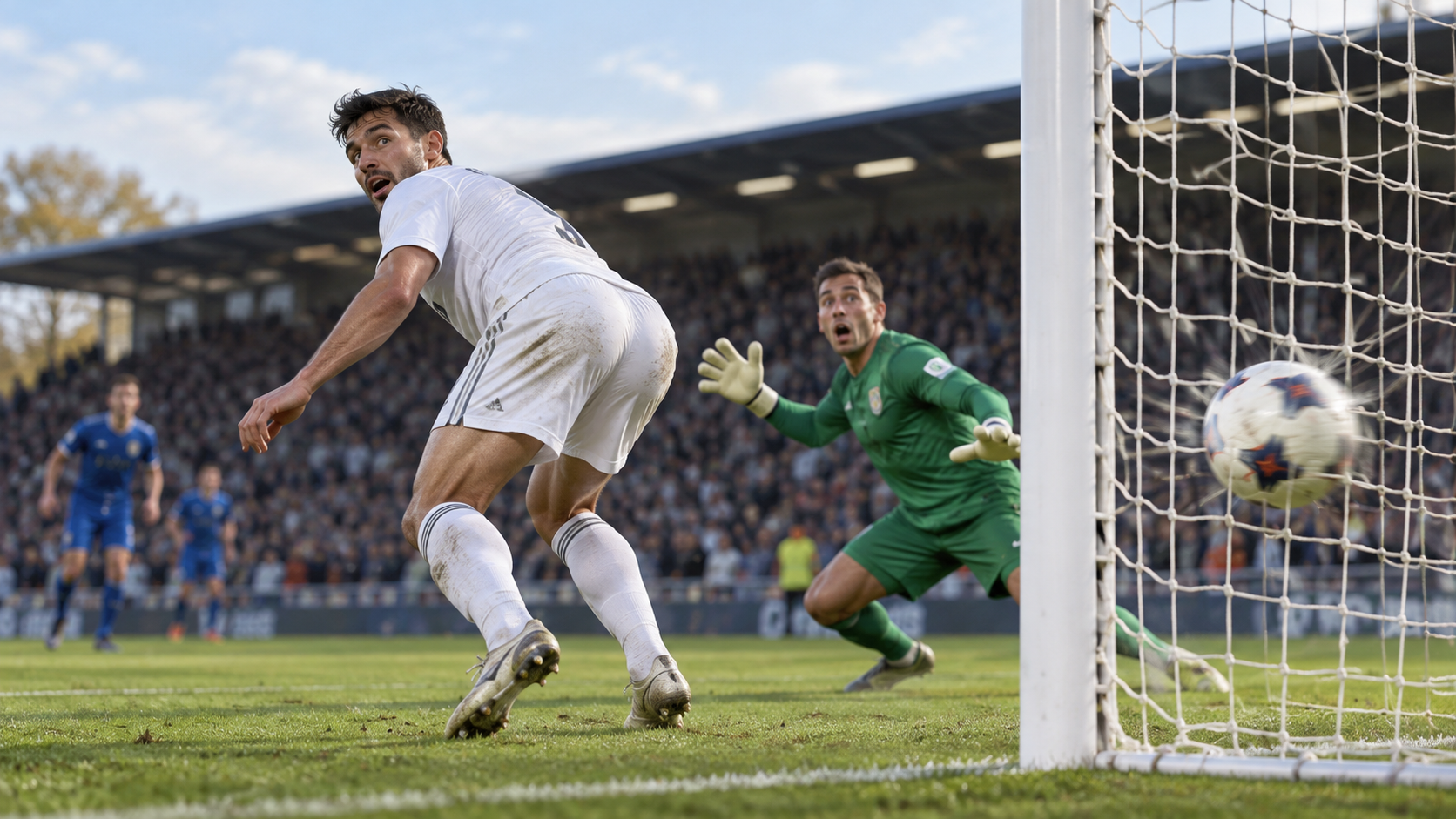
“Oli McBurnie has returned to the Scotland squad,” John Cant pointed out last week. “After 20 appearances without a goal, he recently said in an interview: ‘I would gladly take a tap-in on Saturday, or even one that goes in off my backside.’ Players often mention scoring with that part of the body when discussing the end of a drought, but has it ever really happened?”
The ideal response would have involved a normally reliable goalscorer ending a lengthy barren spell when a wayward clearance struck his rear and slowly rolled across the line. Sadly, no exact example emerged. Even so, goals scored in this unusual fashion possess a certain charm, so here are some memorable cases.
The first three examples concern players who had not been regular scorers but did finally get off the mark. “Dean Coney did it for Norwich during a 2-2 draw with Aston Villa in 1989,” Gary Southwell explains. “He blocked Nigel Spink’s attempted clearance, which rebounded off his backside and entered the net. It proved to be his only Norwich goal.”
A similar feat occurred in international football several years later. “Australia’s Robbie Slater, a Premier League winner with Blackburn, is one example,” writes Rohan Back. “Slater registered his first Australia goal with his backside against the Solomon Islands in his 21st senior international appearance.”
Slater opened the scoring in a 6-2 victory during qualifying for the 1998 World Cup in France. Australia coach Terry Venables responded with an awkward grin, perhaps reflecting on how he had gone from watching Gazza’s spectacular strike against Scotland to witnessing a fortunate ricochet against the Solomon Islands within a year.
Another example came at Ninian Park in May 2002, when a playoff semi-final was decided by a Guinean forward’s posterior. “Souleymane Oularé made only two appearances for Stoke City and scored once, in the playoff semi-final against Cardiff,” Mike Richardson recalls. “His extra-time winner sent Stoke into the final and turned him into something of a cult hero.”
After losing the home leg 2-1, Stoke forced extra time at Ninian Park through James O’Connor’s 90th-minute goal. With five minutes remaining in the additional period, O’Connor’s free-kick struck Oularé before bouncing into the goal. Oularé had entered as a substitute while Stoke pursued an equaliser and had previously spent almost four months out of the side.
“He arrived in December 2001 but missed most of the campaign after suffering a potentially fatal blood clot following his debut against Northampton,” Simeon Goldstraw adds. “Stoke had spent four seasons in the third tier, the lowest level in the club’s history, before defeating Brentford in the playoff final. A local newspaper later published a detailed account of the episode.”
Oularé remained among the substitutes for the playoff final, which Stoke comfortably managed after taking an early lead. He never represented the club again, ending his Stoke career with only 80 minutes on the pitch.
William Saliba has enjoyed a much longer spell with Arsenal. The defender scored off his backside against Manchester United during the 2024-25 season, while Thierno Barry used his rear to guide the ball over the line and secure Everton’s victory at St James’ Park last season.
In the Women’s Super League, a significant deflection off Sjoeke Nüsken gave Chelsea a 3-0 advantage in an important meeting with Arsenal in March 2024, although it remains unclear whether the ball struck her backside or her leg.
The final example is a celebrated goal at Tannadice in 2010, where Rangers’ pursuit of a domestic treble ended in a Scottish Cup quarter-final loss to Dundee United. David Robertson scored the match’s only goal in highly unusual fashion. It may not qualify as a definite backside finish, but the incident is still worth watching.
“Andy Burnham and Mark Carney attended the recent Carabao Cup tie between Everton and Wolves,” Greg Hunt writes. “Aside from European finals, have two national leaders ever attended the same club match in the UK?”
The British prime minister and his Canadian counterpart both support Everton and were present for last month’s 1-0 victory over Wolves. Burnham has previously been photographed running in a vintage shirt carrying the Hafnia sponsorship, though Chris Greenhough notes that he is not the first occupant of 10 Downing Street to display his club loyalty.
“Tony Blair, who is widely known as a Newcastle supporter, took Bertie Ahern to two matches between Newcastle and Manchester United. The first was at St James’ Park in 1997, when Andy Cole scored the only goal in a 1-0 away victory. They also attended the 1999 FA Cup final at Wembley, where Manchester United won again on their way to completing the Treble.” In that sense, Blair lost 2-0 to Ahern, since the former Irish taoiseach has supported Manchester United throughout his life.
“Such occasions remain uncommon. David Cameron, associated at different times with Aston Villa and West Ham, welcomed President Xi to Manchester City’s training complex for a summit in 2015, but domestic fixtures rarely appeared on his itinerary. He did, however, watch the 2012 Champions League final on television alongside Barack Obama and Angela Merkel.”
Delayed suspensions
“Oxford United goalkeeper Simon Eastwood was dismissed near the end of an EFL Trophy match at AFC Wimbledon on 9 January 2024, with Oxford eliminated after a 2-0 defeat,” Martin Brodetsky begins. “Because the club then spent the following two seasons in the Championship, Eastwood’s ban only became relevant again for Tuesday’s fixture against Exeter. Is 999 days, or two years, eight months and 25 days, the longest interval between a red card and the resulting suspension?”
Mykola Kozlenko provides the case of Éric Matoukou, whose suspension continued two years after his dismissal, although the complete story stretches much further. “Matoukou was shown a red card while representing Genk against Porto in a Europa League qualifier on 19 August 2010 and received a two-match ban,” Mykola says.
“He sat out the first match on 26 August 2010, when Genk were knocked out. After moving to Dnipro in Ukraine in 2011, he was not registered in the club’s Europa League squad for either of its two qualifying fixtures. He later joined Arsenal Kyiv on loan and appeared against Mura in another Europa League qualifier on 2 August 2012.”
Since Matoukou had not completed the second match of his original suspension, his appearance caused Arsenal Kyiv to forfeit the game, while Uefa reset his two-match punishment. He missed the return fixture, serving the opening match of the ban once more, but the second game remains outstanding.
“Dnipro subsequently played eight Europa League fixtures after Matoukou returned, but he was never included in their European squad. He departed in 2014, and none of his later teams, including Lierse, Inter Turku and Pafos, qualified for European competition. As a result, he has still not completed the second match of the suspension.”
Matoukou is now 43 and most recently played for Belgian amateur club Sprimont Comblain, making it extremely unlikely that he will ever finish serving a ban imposed more than 16 years ago.
Archive
“Football’s fastest goals are widely documented, but has a team ever equalised during the opening minute?” James W asked in 2017. “And what are the quickest matches to reach scorelines such as 2-2 or 3-3?”
“One question has a straightforward answer from an early match in Coventry’s successful Checkatrade Trophy campaign, at home against Northampton in October,” John Baker explains. “Dan Agyei produced an excellent individual goal for Coventry after only 20 seconds, but Marc Richards levelled for Northampton about a minute later. The score was therefore 1-1 after roughly 90 seconds.” Coventry eventually won 3-1.
Dirk Maas suggests an extraordinary Serie A encounter from 13 September 1992 between newly promoted Pescara and defending champions Milan. Massimiliano Allegri put Pescara ahead in the opening minute, Paolo Maldini equalised two minutes later and Gianluigi Lentini gave Rossoneri the lead in the fifth minute. Franco Baresi then scored own goals in the 12th and 14th minutes, turning the match around and making it 3-2 to Pescara. The hosts added another in the 23rd minute, before Marco van Basten struck twice in quick succession in the 37th and 39th minutes to produce a 4-4 half-time score. Van Basten completed his hat-trick after the interval as Milan prevailed 5-4.
Can you help?
“After 70 years with Adidas, Germany’s national team will switch to Nike. Is that the longest kit-manufacturing partnership ever, and which club currently has the longest-running agreement?” Paul Savage asks.
“Since stoppage time was introduced in 1891, has any match in England’s top four divisions ended without any additional minutes being played?” asks Dave Blackhurst.
“Scotland had a player dismissed in each of their two most recent matches, against Switzerland and North Macedonia,” Stuart McLagan writes. “That made me wonder: what is the longest sequence of consecutive games in which a club or national side has had someone sent off every time?”
“George Desmond Kamurasi, a goalkeeper for English ninth-tier club SE Dons, was chosen to become the new king of Uganda’s Tooro kingdom, although reports say he turned down the position. What is the highest standard of football reached by a member of royalty, excluding players whose names or nicknames merely contain royal titles?” Nathan Eaton asks.
“Scott McDonald, who scored regularly for clubs including Motherwell and Celtic, earned 26 caps for Australia without finding the net. Has any other striker made more international appearances without scoring?” asks Brian Arthur.
“Harry Kane now ranks seventh among Bayern’s leading scorers and remains Tottenham’s record goalscorer. Jimmy Greaves, whom Kane surpassed at Tottenham, also occupies seventh place on Chelsea’s all-time list. Have any other footballers appeared in the top 10 scoring rankings of two or more clubs?” Owen Powell asks.
“Scotland’s men reached a highest Fifa ranking of 13th in 2007 and fell as low as 88th in 2005, producing a difference of 75 places,” Bogan Kotarlic writes. “Is that the widest gap between a national team’s best and worst positions?”
What do you feel about this post?

Like

Love

Happy

Haha

Sad