Leaving out the captain who has carried the side through much of the past five years was an enormous gamble for a manager fighting to keep his position. Michael Carrick took that risk by excluding Bruno Fernandes against Bournemouth. The decision backfired, and although Carrick understood what failure might mean for his future, responsibility should not fall on him alone.
Carrick insisted that Fernandes was omitted solely for tactical reasons, though the captain’s criticism of his manager after the damaging loss to Como was unlikely to have helped. Carrick evidently did not share Fernandes’s concerns about the team’s failure to press during that Champions League match. It was notable, however, that Lisandro Martínez remained in the lineup despite claiming a week earlier that director of football Jason Wilcox was holding the club back.
Fernandes has struggled to reach his usual level this season, registering three Premier League goals and one assist, all during the same match against Ipswich. Giving another player a chance in the No 10 position was therefore understandable, particularly in a squad crowded with attacking midfielders. Yet with almost nobody performing well, retaining a frustrated Fernandes may still have been the wiser option. Since his arrival in 2020, United have won close to half of the league games he has started, compared with fewer than one in three when he has been unavailable.
Fernandes is sometimes criticised for his body language when matches turn against him, but those reactions also reflect how deeply he cares. He may not resemble traditional captains such as Bryan Robson or Roy Keane, yet he remains the player most likely to demand higher standards. A Stretford End banner featuring those former leaders alongside Eric Cantona underlined that expectation. Those standards have now fallen, leaving a mid-table side whose problems are intensified by an apparent lack of determination.
United played with little urgency in either their decisions or their execution. One potentially dangerous move slowed to a halt before the ball was worked all the way back to Senne Lammens, prompting justified jeers from the crowd. The sequence felt symbolic of a team going nowhere and suggested that Carrick’s time in charge was approaching its conclusion.
Speculation about what might have happened is of little value, much like the contribution of Youri Tielemans, who replaced Fernandes. The experienced midfielder has failed to make a strong impression since arriving from Aston Villa in the summer, and the additional responsibility did not improve his performance. He moved the ball too slowly and repeatedly surrendered possession against a Bournemouth side pressing aggressively in pairs. Expected to provide imagination in advanced areas, the Belgian instead looked overwhelmed.
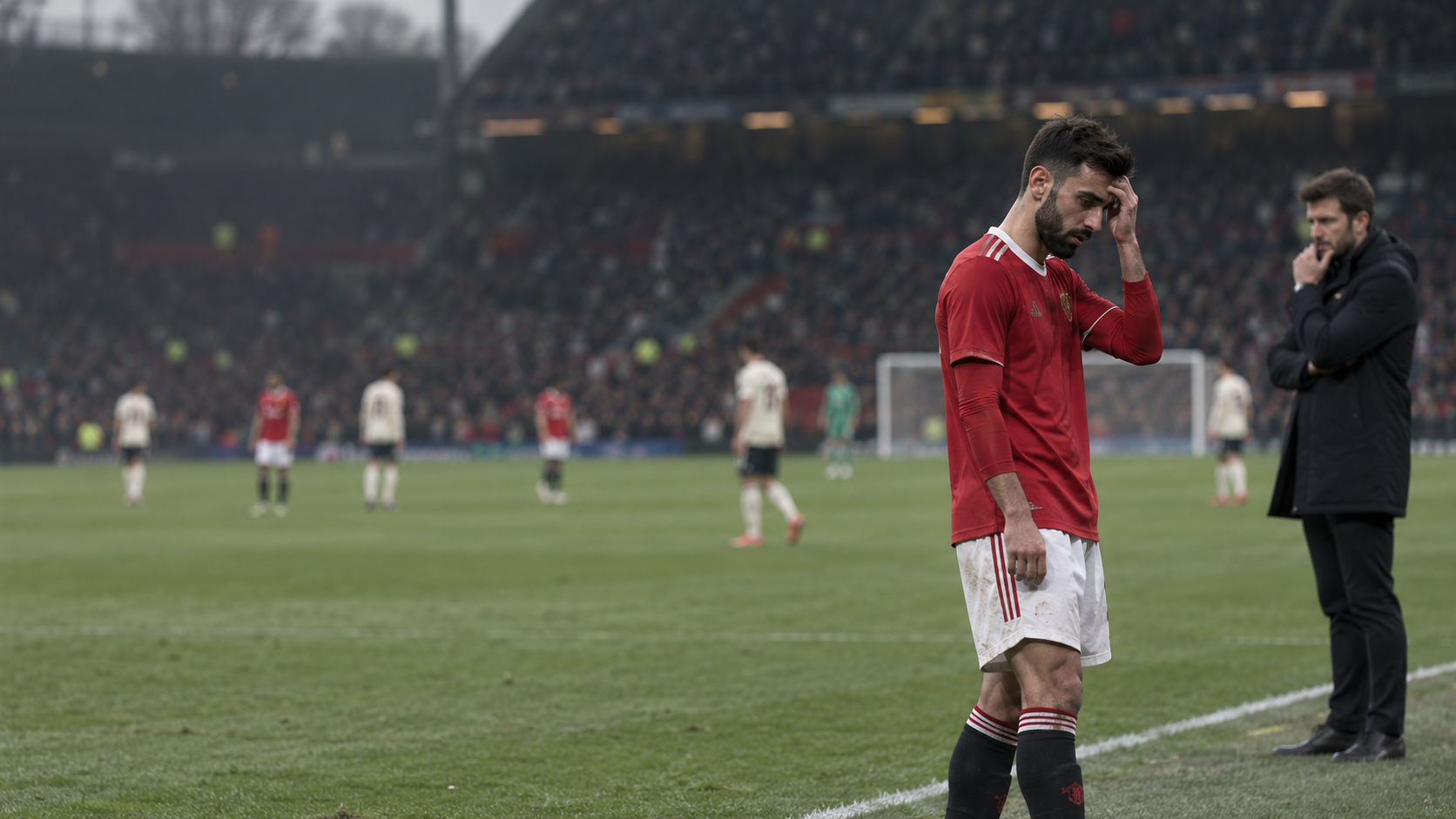
Bournemouth’s opening goal came from weak defending and was followed by the predictable sight of a dejected Fernandes sitting deep in the dugout. The goal captured the gloomy atmosphere around Old Trafford: Ayden Heaven conceded an unnecessary free-kick, and Rayan was then left unmarked at the far post to volley into the net. Fernandes appeared thoroughly unhappy, a feeling shared by most of those inside the stadium.
United’s shortage of speed across the field makes quick distribution in important areas essential, but Tielemans could not provide it. His most significant first-half moment was a booking, which made his substitution at the interval unsurprising. Carrick then turned to Matheus Cunha, asking him to operate behind the struggling Bryan Mbeumo in the hope that he could finally inject some energy into the attack.
Carrick has inherited an uneven squad that lacks sufficient quality in several crucial positions. On the evidence of Sunday’s display, it was difficult to believe that United were the Champions League side while Bournemouth were competing in the Europa League. Bournemouth’s intelligent recruitment has delivered players such as Adrien Truffert and Rayan, both of whom could immediately strengthen United, for a combined cost far below the fee paid for Harry Maguire.
The third goal resulted from a disastrous combination of mistakes by Lammens and Maguire. The goalkeeper rushed from his line too quickly, while the defender lacked the pace to recover. Evanilson reacted first and finished decisively, ending any remaining doubt about the outcome. Fernandes returned to the bench wearing an expression of complete disgust. Carrick’s decision to introduce academy player Shea Lacey while leaving his captain on the sidelines added one final humiliation.
This decline cannot be blamed on a single individual because the problems extend throughout the club. Carrick deserves a share of the criticism, but the Glazers, Sir Jim Ratcliffe, Wilcox and Omar Berrada carry greater responsibility. United appear poorly equipped to compete, and much of the supporters’ anger was directed toward the directors’ box. Fans called for the owners to sell the club and leave, using a varied collection of chants against the leadership. Wilcox received especially fierce criticism, with his recruitment decisions having placed Carrick in a difficult position before the campaign even began.
Supporters sang Carrick’s name, making it clear that the final whistle boos were not primarily aimed at him. The manager, at least for the moment, walked around the pitch and received applause from fans who had jeered the players. Another chapter appears close to ending, and optimism is increasingly difficult to justify. Changes are likely to follow, but they may still fall well short of what the club requires.
What do you feel about this post?

Like

Love

Happy

Haha

Sad