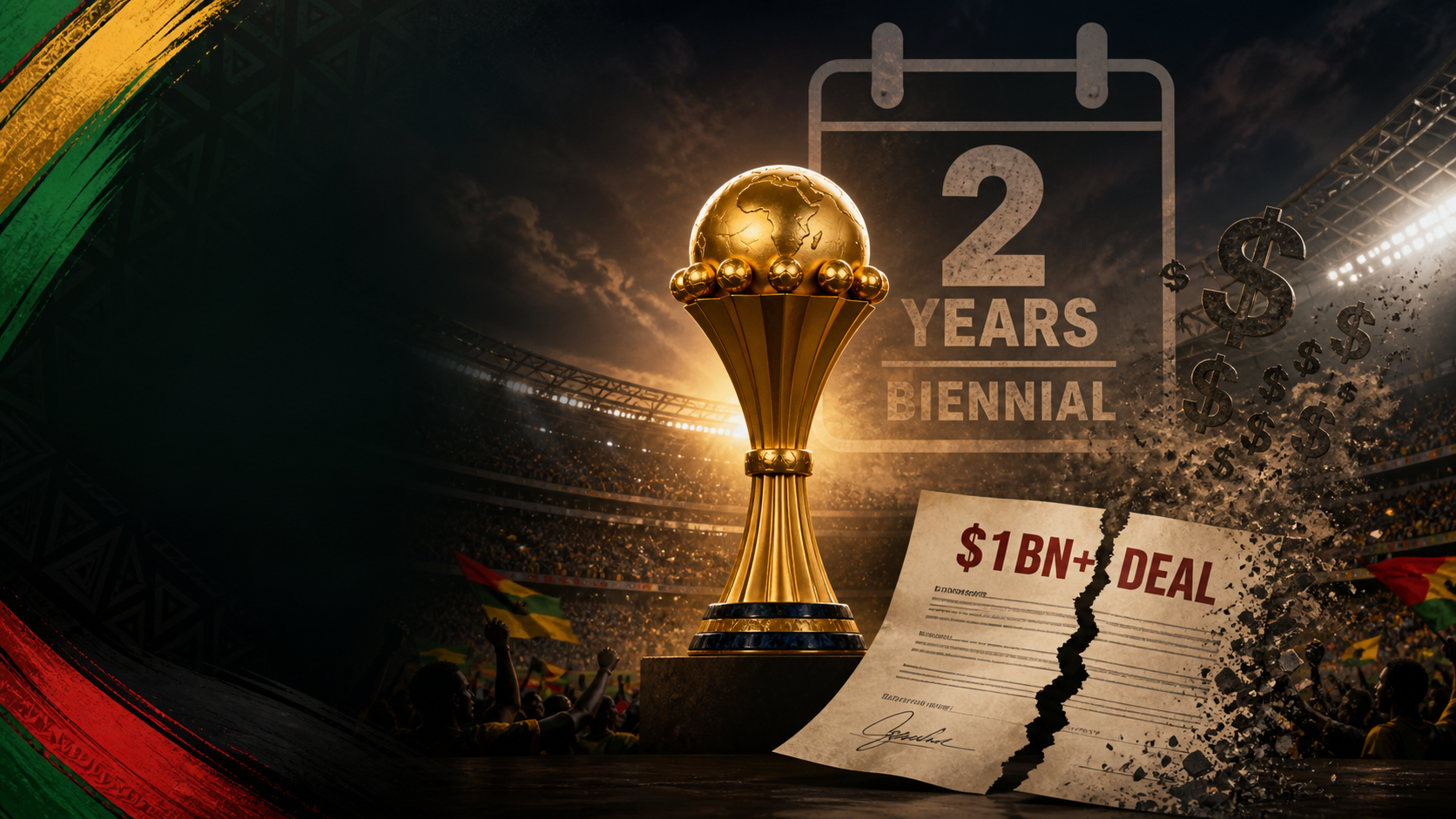
The Confederation of African Football (Caf) withdrew from an agreement guaranteeing at least $1bn in revenue over eight years after deciding to hold the Africa Cup of Nations every four years instead of every two.
On 5 July 2025, one day before the postponed Women’s Africa Cup of Nations began in Morocco, Caf president Patrice Motsepe said in Rabat that the successful bidder would be announced at the appropriate time. His comments followed lengthy talks about the bidding process during an executive committee meeting.
He said substantial progress had been made on the eight-year partnership, which had been presented in Addis Ababa as being worth $1bn.
On 23 July, four days after the World Cup final in New York, Caf launched another tender covering the marketing and commercial rights for the 2028, 2032 and 2036 Africa Cup of Nations (Afcon) competitions. Interested parties had until 24 August to submit their proposals.
This new tender differed significantly from the 2025 process, which offered Caf’s entire portfolio of competitions as a single package.
Caf communications director Luxolo September confirmed that the move to stage Afcon less frequently was the sole reason the nearly completed 2025 bidding process had been cancelled.
September explained that, after reviewing the bids and presentations, Caf began detailed negotiations with shortlisted candidates during the latter half of 2025 to clarify the exact terms of their offers.
He said the Caf executive committee unanimously agreed on 20 December 2025 to place Afcon on a four-year schedule, describing the decision as beneficial to African football and consistent with the international match calendar. Because this substantially altered the commercial rights being offered, the existing 2025 Invitation To Tender process could not continue in its original form.
Caf has now gone seven years without a long-term agreement designed to protect its financial future. Its first arrangement of this kind was a 2016-2028 contract with French company Lagardère, signed while the late Cameroonian official Issa Hayatou was Caf president and carrying a minimum revenue guarantee of $1bn.
Suketu Patel, who previously chaired Caf’s finance committee, said in 2019 that a team led by him and then general secretary Hicham El Amrani had agreed the memorandum of understanding with Lagardère in Zurich in May 2015.
Patel said the team also met Infront that day. Its preliminary proposal guaranteed $450m over eight years, compared with Lagardère’s offer of $1bn across 12 years.
He noted that Caf’s 2009 contract guaranteed $150m, although the organisation ultimately earned about $350m during that period. Officials expected the subsequent 12-year agreement to generate approximately $1.3bn.
Patel added that although he and Hayatou disagreed politically, they had no disputes over Caf’s financial administration. He said Hayatou respected the procedures established to promote proper governance.
The agreement was nevertheless ended unilaterally in December 2019, when Ahmad Ahmad was serving as Caf president after succeeding Hayatou.
A lengthy case before the International Chamber of Commerce eventually resulted in Caf paying Lagardère a final $50m settlement for breaching the contract. The payment was made a little more than a year after Motsepe became president and shortly before the 2022 World Cup in Qatar.
A former football association president with financial expertise said sponsors could not reasonably be expected to pay the same price for rights to two Afcon tournaments over eight years when the previous schedule would have delivered four.
What do you feel about this post?

Like

Love

Happy

Haha

Sad