
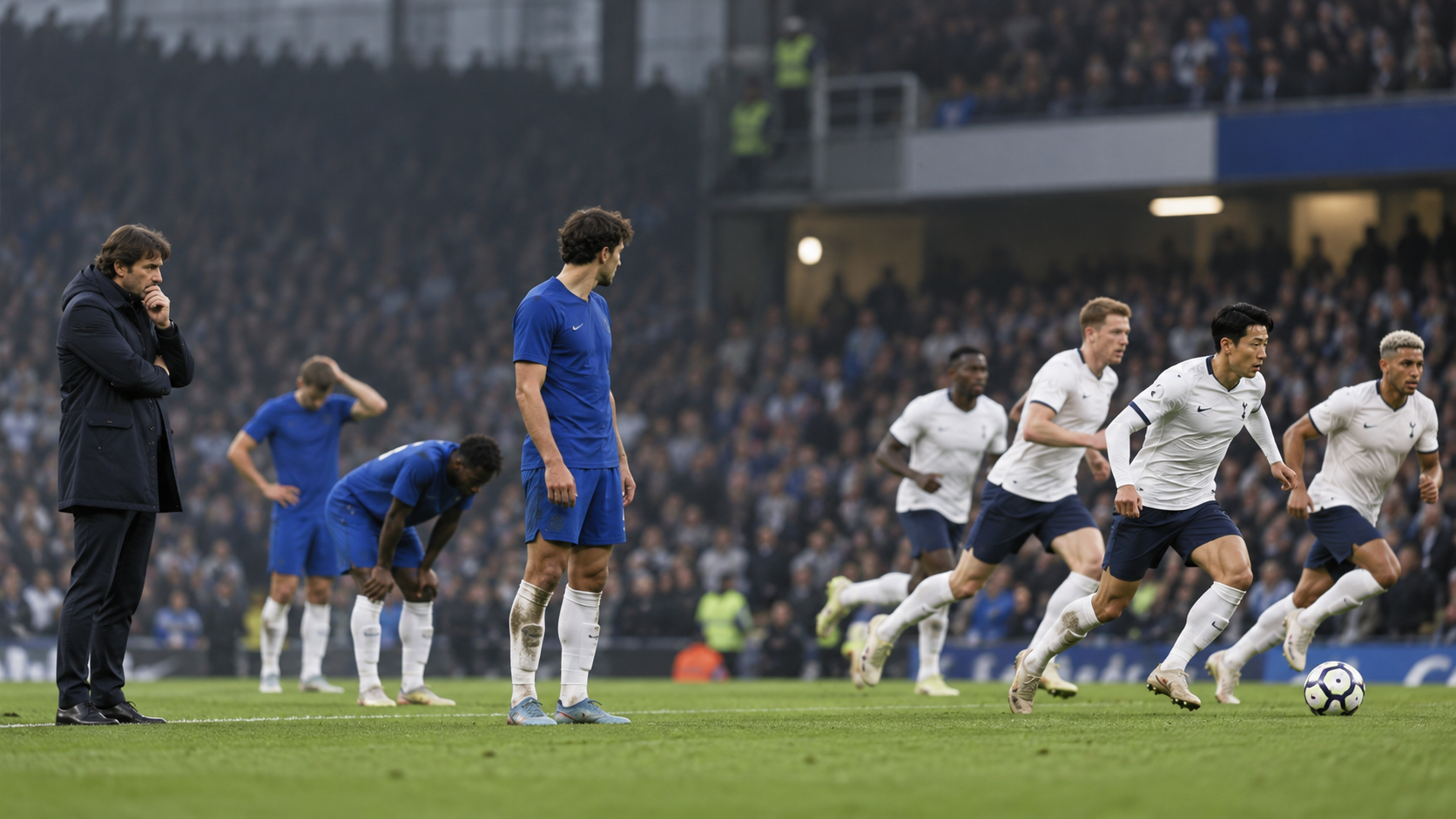
A peculiar moment unfolded at Stamford Bridge in the 76th minute, with the match still goalless. It was the kind of scene that briefly made everything feel backward and disorienting.
Tottenham won a corner on the left after a contest that had largely resembled a prolonged training drill, with both teams carefully following their tactical instructions but producing little excitement.
Appropriately, it took a flaw in the plan to bring the game to life. Chelsea set-piece coach Austin MacPhee stood on the touchline directing players as usual, but this time he was telling them to move out of their own penalty area. They pushed forward, reduced the number of defenders around goal and prepared for a possible counterattack.
Chelsea had used the same approach at a corner in the 52nd minute. Ten players occupied positions farther up the pitch, leaving only a small group inside the area to challenge for the ball. The delivery dropped into one of the large gaps, prompting an enthusiastic response from the crowd.
It is difficult to know where this unusual tactic began. Like many modern trends, it appears to have emerged without anyone being entirely certain who introduced it or why. On this occasion, however, it proved decisive.
The next corner swept directly into the space Chelsea had left exposed. In the wet and windy conditions, the ball continued through the open area before Mike Penders attempted to punch it clear and instead sent it into his own net.
MacPhee joined Chelsea during the summer after the club triggered his release clause at Aston Villa. Following the goal, he walked thoughtfully along the touchline with a hand on his chin, apparently considering how the failed routine might be assessed.
Penders was clearly responsible for the immediate error, but the broader circumstances offered some explanation. With little protection in front of him and a wet ball moving unpredictably in the wind, the goalkeeper faced a difficult situation. He is most comfortable with the ball at his feet and is known for stepping into central defence at Strasbourg, but this particular assignment did not suit his strengths.
The failed tactical gamble at least caused the match to open up. Soon afterward, Cole Palmer received a second yellow card for fouling Conor Gallagher. In the 87th minute, Mathys Tel drove forward and finished neatly inside the near post. Roberto De Zerbi responded by charging onto the pitch in an animated and unconventional celebration.
Before those incidents, the afternoon had been dominated by rigid tactical structures. Matches of this kind are sometimes praised as absorbing strategic contests, but this one was mostly uneventful. During the first half, the home crowd repeatedly watched Chelsea attempt to draw out a press that Tottenham were not actually applying, leaving players waiting for pressure that never arrived.
By full time, two conclusions stood out. The first was that Chelsea had performed poorly. Their problems may still be structural. After years of heavy spending, the club now operates like a rapid player-trading business, with a constant flow of arrivals and departures. Without João Pedro, Chelsea lacked a focal point and offered almost no attacking threat, while Danny Welbeck remained on the bench.
Xabi Alonso deployed Palmer and Morgan Rogers in an unclear attacking role somewhere between playmakers and centre-forwards. Much has been said about the freedom Alonso gives his attackers while maintaining stricter positioning behind them. Here, that freedom often resulted in players standing in the rain without knowing which movement to make.
Chelsea remained motionless for much of the match and showed little intensity, aggression or urgency. When Palmer received his first booking in the 69th minute, an argument between the benches followed, with staff members in padded coats pushing and confronting one another. The home supporters welcomed the dispute because it finally provided some emotion and competitive energy.
Chelsea had approached the London derby with a cold, system-driven style and never found momentum. After 40 minutes, Palmer had touched the ball only eight times, while the hosts had managed just 27 per cent possession against Spurs. One of the few sources of tension was watching Alonso’s lightweight jacket become steadily soaked by the rain, another questionable choice on a disappointing afternoon.
The second conclusion was that Tottenham played well. Given permission to control possession, and helped by an impressive display from Mateus Fernandes in deep midfield, Spurs secured their finest result of the season. It was also an important success for their manager, who visibly enjoyed the occasion.
De Zerbi presents an intriguing contrast. He is emotional, energetic and openly passionate, yet he is equally devoted to tactical structures and carefully rehearsed patterns. His reactions were entertaining throughout the match. Around the hour mark, a mistake in Tottenham’s positioning prevented the team from launching a coordinated press.
De Zerbi responded by jumping into the air and shouting in frustration. Shortly afterward, Omar Marmoush passed the ball directly to a Chelsea player, yet the manager barely reacted, illustrating how differently he judged individual errors and failures within the team’s tactical structure.
For a period, James Maddison appeared to be playing with greater freedom than anyone else. He looked forward, carried the ball and improvised as attacks developed. In the 49th minute, he sat down inside the centre circle and could not continue, creating a potential concern. Even so, it remained an excellent afternoon for De Zerbi and Tottenham, although the outcome ultimately depended on a failed punch and an unnecessarily complicated piece of touchline instruction.
What do you feel about this post?

Like

Love

Happy

Haha

Sad